


- Real estate investment accounting software keeps books by property and by entity, tracks fixed assets and produces financial, investor and tax reports.
- What it must support depends on the ownership structure: an individual landlord, a partnership or syndication, a fund or a REIT.
- US and UK rules differ, so check the tax forms and reporting your structure needs before you compare vendors.
Introduction
A portfolio of rental properties produces a lot of accounting work: rent and expenses for each property, loans, improvements, distributions to partners and tax forms at year end. General bookkeeping tools may be sufficient for a simple portfolio. Complexity increases when the team needs separate entity books, intercompany accounting and investor reporting, so evaluate those capabilities explicitly.
This guide covers investment accounting for US and UK real estate businesses. It explains what the software does, which tax reports each ownership structure needs in each country, the features to test in a demo, how to read a vendor's security report, a weighted scorecard and the cases where custom or integrated accounting is the better route. Tax sections describe the rules in general terms and are not tax advice.
What Is Real Estate Investment Accounting Software?
Real estate investment accounting is the bookkeeping and reporting of income, expenses, assets, debt and investor capital for property held as an investment. Real estate investment accounting software is the system that records those transactions by property and by legal entity and turns them into financial statements, tax reports and investor statements.
Financial reporting and tax reporting are separate requirements. The software should preserve the accounting carrying value, tax basis and adjustments needed under the entity's applicable reporting framework, rather than treating a tax depreciation schedule as the complete accounting record.
Compared with general bookkeeping tools, real estate investing accounting software adds three things:
- Many properties and entities in one system. Each property can have its own income and expenses, and each LLC, partnership or company keeps its own books, with consolidated reports on top.
- Fixed asset tracking. Purchase price split between land and building, improvements, valuation records and tax depreciation or the equivalent UK records.
- Investor reporting. Capital accounts, distributions and the year-end information each partner or shareholder needs for their own tax return.
Individual landlords often manage with a packaged product. Firms with complex structures, such as several funds, intercompany loans or their own investor portal, sometimes need custom accounting software development to keep all of it in one ledger.
Who Needs It: Individual Investors, Syndicators, Funds and REITs
The right accounting software for real estate investors depends on how the property is owned, because the ownership structure decides which tax reports the books must feed. So before comparing accounting software, real estate investors should write down their entities, investors and the reports each one needs. The US rules below come from IRS publications and form instructions for the 2025 tax year.
Individual investors and small portfolios
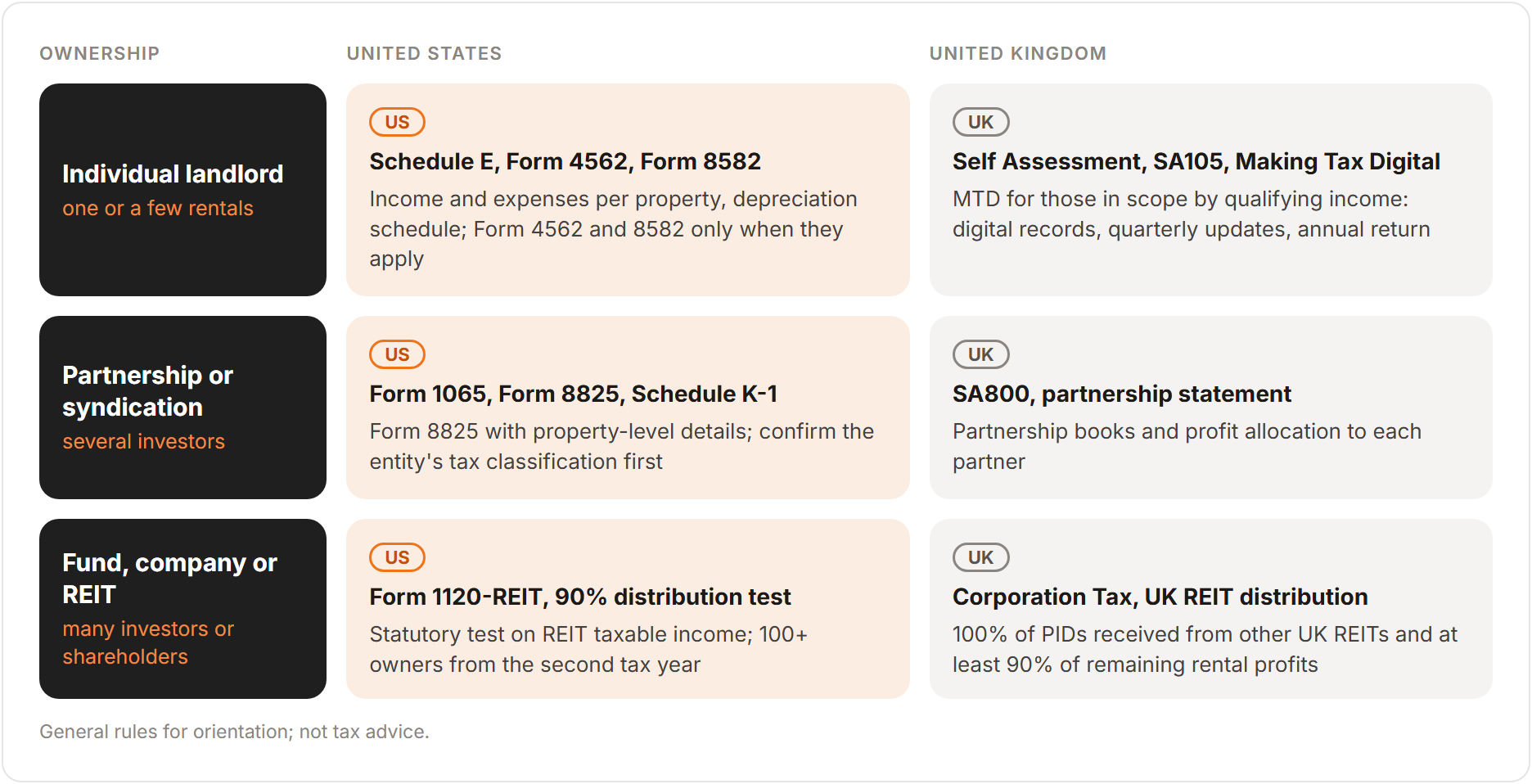
For a landlord with a few rentals, investment property accounting software mainly needs clean property-level records. According to IRS Publication 527, individual landlords generally report rental income and expenses on Schedule E. Form 4562 is required in specified circumstances, including when depreciable property is placed in service during the tax year; Form 8582 may also be needed for passive activity loss limitations. Software for this group should keep income and expenses per property, hold the depreciation schedule and export figures in a form a tax preparer can use.
Syndicators and partnerships
Syndications and joint ventures may involve multiple property-holding entities and investors managed by one finance team. The software must preserve separate entity books while supporting the required investor allocations and reporting. Partnerships and S corporations report rental real estate income and expenses on Form 8825, with lines completed for each property. The partnership then issues a Schedule K-1 to each partner to report that partner's share of income, deductions and credits.
Confirm the entity's tax classification before selecting its reporting workflow. An LLC is not automatically taxed as a partnership. Once the classification is clear, the software needs entity-level books, capital accounts and allocations that follow the partnership or operating agreement.
Funds and REITs
Real estate fund accounting software adds layers on top: several investor classes, capital calls, preferred returns and waterfalls, and reporting to many limited partners. A REIT has its own rules. According to the Instructions for Form 1120-REIT, a REIT files Form 1120-REIT, its beneficial ownership must be held by 100 or more persons, and its deduction for dividends paid must generally equal or exceed 90% of its REIT taxable income, with adjustments set out in the instructions. The 100-person ownership requirement generally applies from the REIT's second tax year. The accounting system has to track distributions against the distribution requirement during the year, not only at year end.
UK landlords, partnerships and REITs
The UK uses different forms and rules. Individual landlords report property income through Self Assessment on the UK property pages (SA105). Making Tax Digital for Income Tax applies to eligible sole traders and individual landlords according to their qualifying income: combined gross income from self-employment and property before expenses. Qualifying income over £50,000 in 2024-2025 brings a person into MTD from 6 April 2026; the corresponding thresholds are over £30,000 in 2025-2026 for April 2027 and over £20,000 in 2026-2027 for April 2028. Exemptions may apply.
Those within scope must keep digital records, send quarterly updates and submit their annual tax return through compatible software. Ask whether the proposed software or connected workflow supports every required step and income source.
Partnerships file a partnership tax return (SA800) with a partnership statement that allocates profits to partners, and HMRC has said partnerships will join Making Tax Digital later. Companies holding property file Corporation Tax returns. A UK REIT must generally distribute at least 90% of the profits of its property rental business as property income distributions, as HMRC's Investment Funds Manual explains. UK REITs must also distribute 100% of property income dividends received from other UK REITs, alongside the applicable 90% requirement for the remaining property rental profits.
Two UK differences affect the books. Individual landlords get relief for residential finance costs only as a basic-rate tax reduction, while companies are not affected by that restriction. And capital allowances are generally not available for items in an ordinary residential dwelling house, while the replacement of furniture, appliances and similar items may qualify for replacement of domestic items relief.
| Ownership type | Forms and reports | What the software must do |
|---|---|---|
| US individual landlord | Schedule E; Form 4562 in specified circumstances, such as property placed in service during the year; Form 8582 when passive loss limits apply | Income and expenses per property, depreciation schedule, export for the tax preparer |
| US partnership (confirm tax classification first) | Form 1065, Form 8825 with property-level details, and Schedule K-1 for each partner | Entity-level books, capital accounts, allocations and K-1 data |
| US REIT | Form 1120-REIT; distributions tracked against the statutory 90% test on REIT taxable income | Entity books, shareholder records, distribution tracking during the year |
| UK individual landlord | Self Assessment with UK property pages (SA105); Making Tax Digital for those in scope by qualifying income | Digital records, quarterly updates and the annual return through compatible software, finance cost records |
| UK partnership | SA800 with partnership statement | Partnership books and profit allocation to each partner |
| UK company or REIT | Corporation Tax return; for a UK REIT, distribution of 100% of PIDs received from other UK REITs and at least 90% of the remaining qualifying property rental profits. | Company books, distribution tracking, group reporting |
Key Features to Look For
The features below separate investment accounting from general bookkeeping. For each one, ask the vendor to show it on your own data during the demo.
Property-level and entity-level books
Every transaction should carry two tags: the property and the legal entity. That lets you see results per building, per LLC or company, and for the whole portfolio. Check how the system handles intercompany loans, management fees charged between entities and consolidation, and whether adding a new entity requires a new subscription.
Fixed assets, valuation and tax depreciation
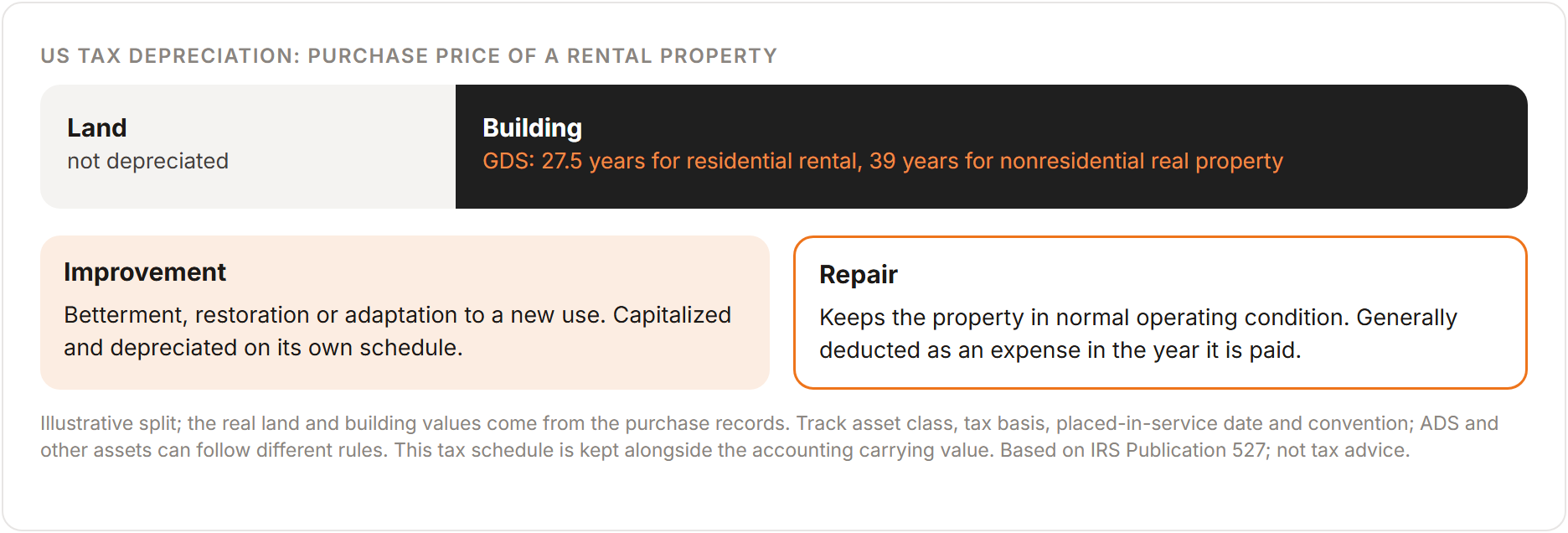
In US accounting software for investment property, tax depreciation is a core function. IRS Publication 527 sets the rules: land cannot be depreciated, and expenses that improve the property must be capitalized rather than deducted as repairs. Under GDS, residential rental buildings generally use a 27.5-year recovery period, while nonresidential real property generally uses 39 years. Other assets and situations requiring ADS can follow different rules. Track asset class, tax basis, placed-in-service date and the applicable convention separately.
The software therefore has to split the purchase price between land and building, keep a schedule for every improvement and separate repairs from improvements. It should hold this tax schedule alongside the accounting carrying value, so book and tax figures can differ without being overwritten.
For UK entities, distinguish financial reporting from tax treatment. Depending on the applicable accounting framework, investment property may require fair-value accounting. Tax deductions follow separate rules, so the system should retain valuation records and book-to-tax adjustments.
Bank feeds and reconciliation
This is where real estate bookkeeping software saves the most time: bank and card transactions come in automatically and are matched to rent, invoices and loan payments. Look for rules that assign recurring transactions to the right property, handling of security deposits held for tenants and a reconciliation view per bank account and per entity. Security deposits should stay separate from rent income in the books.
Investor reporting and K-1 support
Investors expect regular statements: their capital account, contributions, distributions and the performance of the property or fund. At year end, a US partnership needs the data for every partner's K-1, and a UK partnership needs the allocation for its partnership statement. Ask whether the system prepares this data itself or exports it to tax software, and whether investors can see their statements in a portal.
Distributions and fund accounting
Distribution calculations follow the operating or partnership agreement: preferred returns, catch-ups, splits between sponsors and investors, and in a fund, several classes of investors. The software should calculate distributions from the agreement's rules, record them per investor and keep the history for audits. For REITs, distribution tracking must follow the relevant jurisdiction's tax rules. The US test uses a statutory taxable-income calculation, while the UK regime applies a property-rental-business distribution test. The software should retain the calculation basis, adjustments and distribution dates.
Audit trail and permissions
Investors, lenders and auditors rely on the books, so every change to a transaction, account or setting should be logged with the user and time. Roles should limit what each person sees and does, for example by entity, so a property manager cannot edit fund-level entries. Period locks prevent changes to closed months.
Require approval controls for payments, investor distributions and sensitive account changes. Test allocation and waterfall calculations against independently reviewed examples, including rounding, partial periods and corrections.
Integrations and API
Investment accounting usually sits next to other tools: property management software, banks, payment processors, investor portals and sometimes an ERP. Check which integrations work out of the box and whether there is a documented API for the rest. If your stack needs a connector that does not exist yet, that is a separate project in accounting integration.
| Feature | Why it matters | Demo check |
|---|---|---|
| Property- and entity-level books | Results per building, per entity and for the portfolio | Allocate an expense across properties and demonstrate any required intercompany entries. Confirm that each entity's ledger remains balanced. |
| Fixed assets, valuation and tax treatment | Book values and tax depreciation kept apart, correct capitalization | Add a property with a land and building split, add an improvement and show the book and tax values side by side |
| Bank feeds and reconciliation | Less manual matching, accurate cash | Import a month of transactions and reconcile one account |
| Investor reporting and K-1 support | Statements and year-end data for each investor | Produce a capital account statement and the K-1 data export |
| Distributions and fund accounting | Payouts that follow the agreement | Run a distribution with a preferred return and check it against a reviewed example |
| Audit trail and permissions | Trust from investors, lenders and auditors | Attempt to edit a locked period, verify that unauthorized changes are blocked, and demonstrate the approved correction or reopening workflow with an audit trail. |
| Integrations and API | Data flows without re-typing | Show the property management and bank integrations you need |
| UK Making Tax Digital support | Digital records, quarterly updates and the annual return for those in scope | Demonstrate digital records, quarterly updates and the annual return workflow, including any connected software or tax-agent handoff. |
Real Estate Accounting vs Bookkeeping vs Property Management Software
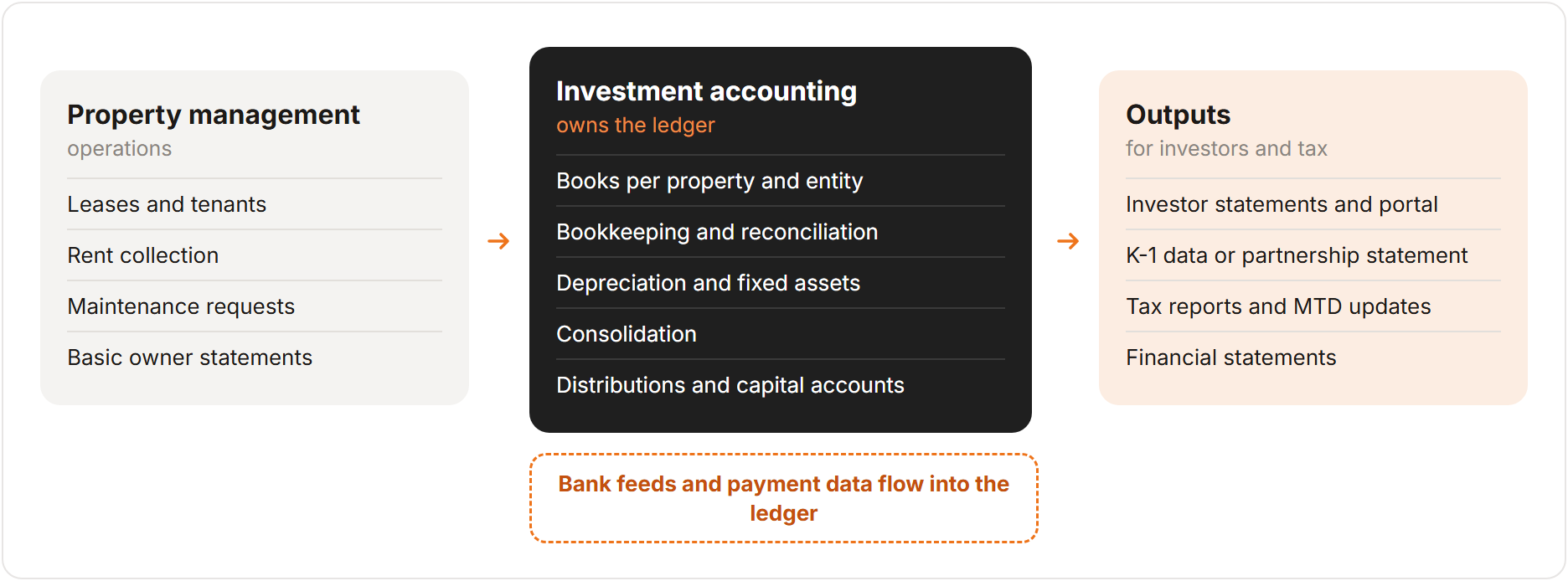
Real estate accounting software is the broad category: it keeps the general ledger, financial statements and tax reports. Bookkeeping for real estate investors is the day-to-day part, recording transactions and reconciling bank accounts, and many tools for small landlords stop there. Property management software runs operations: leases, rent collection, maintenance requests and tenant communication.
The tools overlap. Many property management systems include basic accounting for owners, and many accounting tools have rent tracking. Accounting software for real estate becomes necessary when you need entity-level books, fixed asset and tax records, consolidation and investor reporting that a property management system does not cover. In that setup, the property management system sends rent and expense data to the accounting system, which owns the ledger.
Security and Data: What to Ask Vendors
An accounting system holds bank data, investor details and tax identifiers, so security questions belong in the demo. Many vendors point to a SOC 2 report. A SOC 2 report is an attestation report issued by an independent CPA firm under AICPA standards; it is not a law or a certification of compliance. A Type 1 report describes the design of controls at a point in time, while a Type 2 report also tests how the controls operated over a period, so Type 2 tells you more. Ask for the latest report under an NDA, check the period it covers, which services are in scope and any exceptions the auditor found, and read the controls the report expects you to run on your side. The AICPA's illustrative SOC 2 report shows what these sections look like.
A SOC 2 report does not, by itself, verify the correctness of your tax calculations, investor allocations or financial statements. Test those functions separately.
Also ask how you export your data, in which formats, and what happens to it after you cancel. For UK investors, the vendor's role under the UK GDPR and where data is stored are part of the same conversation.
Before migration sign-off, reconcile opening balances, trial balances, bank balances, investor capital and historical distributions by entity. Record how duplicate imports, rejected transactions and cutover adjustments are handled.
How to Choose: A Scorecard
First, rule out vendors that fail your mandatory requirements, such as support for your entity structure, the tax reports you need or a usable data export. Then score each remaining vendor from 1 to 5 on every criterion during the demo. With weights totaling 100, the weighted average is Σ(weight x score) ÷ 100, which gives a score from 1 to 5.
| Criterion | Weight | Demo question | Score (1-5) |
|---|---|---|---|
| Entity and property structure | 20 | Can you model our entities, properties and intercompany flows without workarounds? | |
| Tax reporting support | 15 | Which reports do you produce for our structure: Schedule E data, Form 8825, K-1 data, SA105 or the Making Tax Digital workflow? | |
| Investor reporting and distributions | 15 | Run a distribution under our agreement and show the investor statement. | |
| Bank feeds and reconciliation | 10 | Reconcile a month of our transactions. | |
| Fixed assets, valuation and tax treatment | 10 | Show the land and building split, an improvement schedule and book versus tax values. | |
| Integrations and API | 10 | Which of our tools connect today, and what does the API cover? | |
| Security and data export | 10 | Share relevant independent assurance evidence, explain its scope and findings, and demonstrate a complete data export. | |
| Total cost of ownership | 10 | What will we pay in year one and year two, including setup and migration? | |
| Total | 100 |
Pricing and total cost of ownership
Pricing models differ: per property or unit, per entity, per user or by assets under management. Licenses are only part of the cost. Budget for setup and chart of accounts design, migration of history and opening balances, training, integrations and add-ons such as investor portals. When you choose accounting software for a real estate company with several entities, ask each vendor for a written two-year quote for your structure and compare the totals.
When Off-the-Shelf Accounting Is Not Enough
Packaged accounting works well for most landlords and many syndicators. A custom or integrated solution is worth considering when:
- Your ownership structure does not fit the product, for example several funds with different waterfalls.
- Your cross-border reporting, currency or entity requirements cannot be supported reliably by available products or integrations.
- Your team consolidates entities in spreadsheets every month.
- You already run an ERP or an old system that holds years of history, and replacing it is riskier than connecting it. Our glossary explains the trade-offs of keeping a legacy system.
- Investor reporting, the portal and the books live in different tools that do not share data.
For US-UK portfolios, test currencies, exchange-rate handling, local tax outputs and reconciliation between entity books and group reports.
It is usually not worth building when a packaged product covers your structure and reports, and the gaps are cosmetic. Our article on custom software vs off-the-shelf covers this choice in more detail. When accounting is part of a wider platform for properties, tenants and investors, real estate software development can bring the ledger, operations and investor reporting into one system. Confirm ownership of bespoke code, repository access and handover terms in the contract.
FAQ
Property management software runs operations: leases, rent collection, maintenance and tenant communication. Real estate accounting software keeps the general ledger, financial statements, fixed asset records and tax and investor reports.
Many property management tools include basic owner accounting, which can be enough for a few rentals. Once you have several entities or investors, the usual setup is a property management system that sends data to a separate accounting system.
Not always. A single-property syndication can often run on accounting software that supports entity-level books, capital accounts and K-1 data, combined with a spreadsheet or portal for distributions.
Real estate fund accounting software becomes worth it when you manage several deals or a fund with investor classes, capital calls, preferred returns and waterfalls, because calculating those by hand gets risky as the number of investors grows.
Under the General Depreciation System, residential rental buildings generally use a 27.5-year recovery period, and nonresidential real property generally uses 39 years, according to IRS Publication 527. Land is not depreciated, so the purchase price has to be split between land and building, and improvements are capitalized and depreciated separately.
This is a tax schedule, not the full accounting record. The UK treats residential buildings differently for tax, so check the rules with a tax adviser in each country.
A Schedule K-1 (Form 1065) is the form a US partnership uses to report each partner's share of income, deductions and credits. Each partner receives one.
If you run a partnership or syndication, your accounting software should at least produce the data for K-1s: capital accounts and allocations per partner. Some products generate the forms, while others export the data to tax software or to your CPA.
Ask for the latest SOC 2 Type 2 report, the period it covers, which services are in scope and any exceptions found. Remember that SOC 2 is an attestation report, not a compliance certificate, and it does not test your tax or allocation calculations.
Also ask about roles and permissions, approval controls, audit logs, encryption, backups, where data is hosted and how you export everything if you leave. UK businesses should also ask about the vendor's role under the UK GDPR.
Eligible individual landlords and sole traders need it when their qualifying income, combined gross income from self-employment and property before expenses, is over the threshold. Over £50,000 in 2024-2025 means MTD from 6 April 2026; over £30,000 in 2025-2026 means April 2027, and over £20,000 in 2026-2027 means April 2028. Exemptions may apply.
Those within scope keep digital records, send quarterly updates and submit the annual return through compatible software. Check that the tool or connected workflow covers every step and income source.
Next Step
Need accounting built around your ownership structure? Use our estimator for an initial development estimate, or book a call to discuss whether to configure, integrate or build.