


SaaS Development
Services

Custom cloud-native SaaS development for startups and enterprises focused on scalability, performance, and long-term ownership.

We build cloud-native SaaS products that scale with your business – from early-stage MVP to enterprise-grade platform.
Full-cycle delivery from a SaaS development company with owned infrastructure and no vendor lock-in. You ship, you own.
Build secure, scalable, and cloud-native SaaS products without sacrificing ownership or future flexibility.
From product strategy and UX to backend architecture, DevOps, and continuous delivery, we create SaaS platforms engineered for growth, reliability, and rapid iteration.

What businesses achieve with Dotcode SaaS development

View all cases
6–10 wk

Typical time to a working SaaS MVP – enough runway to validate product-market fit before committing to a full build

Faster time-to-market when CI/CD pipelines replace manual deployments – less waiting, more shipping

40%

Lower infrastructure cost when auto-scaling replaces always-on over-provisioned servers

100%

Code and IP ownership transferred to you on day one – no lock-in, no shared codebase with other clients

line on background

Why SaaS teams choose Dotcode

Six things that show up in every SaaS development services engagement we run. Not principles – the specific ways we work:

Get a free consultation today!

Let’s talk
Agile Delivery & CI/CD
Two-week sprints, deployable software after each one. CI/CD pipelines go live at the start of the project, not at the end. That means your stakeholders see a working product early, and changes cost far less when they happen in week three than in week twelve. As a SaaS development company, we do not hold the product until it is 'finished' - it is always running somewhere you can see it.
Multi-Tenant Architecture
Customer data is isolated at the schema or database level - not through application logic that can be misconfigured. Tenant onboarding is automated. The architecture handles the next ten customers the same way it handled the first one, without manual intervention. SaaS software development that does multi-tenancy wrong creates security incidents and scaling problems at the same time.
Cloud-Native Engineering
Containerized infrastructure, auto-scaling, and infrastructure-as-code from day one. Kubernetes handles orchestration. Terraform handles provisioning. You are not locked into a single cloud provider because the infrastructure is not tied to one. AWS, Google Cloud, or Azure - or a mix, if that is what your compliance requirements demand.
API-First & Integrations
Every component exposes a versioned API before anyone builds a UI on top of it. That means third-party integrations, mobile clients, and future features can connect without re-engineering the core product. GraphQL and REST depending on the use case. Event-driven architecture where real-time behavior matters.
Security & Compliance
End-to-end encryption, MFA, and role-based access control are architecture decisions, not features added at the end. SOC 2, GDPR, HIPAA, and PCI-DSS compliance paths are scoped during discovery so the data model and access control layer support them from the start. Security testing runs throughout the build, not once before launch.
Post-Launch Support
Post-Launch Support
We stay after go-live. Monitoring dashboards, alert thresholds, and on-call procedures are set up before deployment, not after the first incident. Post-launch iteration on real user behavior is part of how SaaS software development company work should run - the first 90 days of production data tells you things no amount of UAT captures.

SaaS products we build and scale

From a seed-stage startup validating a first hypothesis to an enterprise team replacing legacy infrastructure – the development model adapts to where you are.

Early-Stage Startups

Early-Stage Startups

SaaS product development at this stage means getting to a working, testable product fast without building technical debt that will slow you down at Series A. We scope the MVP honestly: what needs to be built now and what can follow. Ship an MVP in 6–10 weeks, validate the hypothesis, then build what the product actually needs based on real usage.

Growth-Stage Companies

Growth-Stage Companies

You have customers, you have revenue, and the architecture that got you here is starting to show its limits. Scaling bottlenecks, data isolation issues, or an API that was not designed for the integrations customers are now asking for. Custom SaaS development at this stage is as much about refactoring the foundation as it is about new features.

Enterprise Product Teams

Enterprise Product Teams

Enterprise SaaS has different requirements from startup SaaS. Single sign-on, audit logging, role-based access control, data residency options, and compliance documentation that procurement teams will actually review. We build the enterprise readiness layer without rebuilding the product from scratch.

B2B SaaS Founders

B2B SaaS Founders

SaaS development services for B2B products require a different architecture than consumer products – multi-tenancy, permission models, admin dashboards, usage-based billing, and the ability to white-label or configure per customer. We have built across fintech, healthcare, logistics, and operations verticals where the B2B requirements are not optional.

Marketplace & Platform Builders

Marketplace & Platform Builders

Two-sided marketplaces and platform products have their own set of architectural challenges: transaction logic, trust and safety mechanisms, payment processing, and the need to serve two distinct user types from the same infrastructure. SaaS application development for platform businesses requires getting the data model right from the start – it is hard to change later.

Non-Technical Founders

Non-Technical Founders

If you have a clear product vision but no internal engineering team, you need a development partner who can translate that vision into technical decisions without requiring you to understand every tradeoff. We handle the architecture, the stack choices, and the tradeoffs. You own the product, the roadmap, and the IP from day one.

Loyalty programs platform

Full-Stack SaaS Development Services

Our SaaS development services cover every layer of what a production SaaS product requires. If you need the broader context, see our custom software development and web development services.

1

Custom SaaS Application Development

Custom SaaS app development means building a product that fits your specific use case – not adapting a template to your workflow. We build across verticals: fintech, healthcare, edtech, logistics, legal. The architecture is designed for your user model, your data requirements, and your compliance obligations. Every product starts with a discovery phase that produces a data model and API contract before any frontend code is written. SaaS application development that skips this step spends months fixing foundational decisions that were made in a hurry.

2

Multi-Tenant SaaS Architecture

Multi-tenancy is not just a database design decision – it determines how you handle performance isolation, compliance scope, and customer data portability for the entire life of the product. We build schema-per-tenant or row-level isolation depending on your compliance requirements and customer data volume. Tenant onboarding is automated. Scaling one customer’s workload does not affect others. SaaS software development that gets multi-tenancy wrong creates problems that are expensive to fix under load.

3

Cloud-Native SaaS Engineering

Containerized services, infrastructure-as-code, and auto-scaling policies configured from the start. Not after the first traffic spike reveals the limits of an over-provisioned EC2 instance. We build on AWS, Google Cloud, and Azure depending on your requirements – and we build in a way that does not lock you to any one of them. Kubernetes for orchestration, Terraform for infrastructure, and deployment pipelines that ship multiple times per day without manual steps.

4

API-Driven & Headless SaaS Development

An API-first architecture means the product can integrate with any tool a customer uses – now and in three years when those tools change. We build GraphQL and REST APIs with versioning and rate limiting from day one. Microservices where independent scaling matters, event-driven architecture where real-time updates are part of the product. SaaS app development that exposes a well-documented API is a product that enterprise customers can actually evaluate and procurement teams can actually approve.

5

SaaS Migration & Modernization

Legacy systems migrated to cloud-native SaaS product development architecture, with a migration plan that keeps the existing product running while the new one is built. We use the strangler fig pattern for large systems where a big-bang cutover is not an option: new functionality routes to the new architecture, legacy functionality migrates incrementally, and the old system is decommissioned only after the new one has handled production load. No downtime, no data loss, no moment where the entire business depends on a single deployment succeeding.

Custom vs Off-the-Shelf

Custom SaaS development vs off-the-shelf platforms

Bubble, Webflow, and no-code tools get you started. Custom SaaS development is what keeps you moving when they stop.

Fits your product logic
No-code / off-the-shelf

Partial – you adapt your product to the platform’s limitations

Custom by Dotcode

Yes – architecture built for your specific user flows and data model

Scalability
No-code / off-the-shelf

Platform ceiling; performance degrades or costs spike under real load

Custom by Dotcode

Auto-scaling infrastructure sized for your actual traffic patterns

Third-party integrations
No-code / off-the-shelf

Limited to platform’s connector library; custom integrations expensive or impossible

Custom by Dotcode

Any integration your customers need, built against the API contracts they use

Code & data ownership
No-code / off-the-shelf

Platform-owned; migration away is painful and data portability varies

Custom by Dotcode

100% yours from day one – full source code and all data

Compliance (SOC 2 / GDPR / HIPAA)
No-code / off-the-shelf

Vendor-managed scope; your configuration layer carries the compliance gap

Custom by Dotcode

Compliance architecture built into the data model and access control from the start

Change speed
No-code / off-the-shelf

Dependent on platform release cycle and feature roadmap

Custom by Dotcode

Changes deploy on your timeline; no vendor approval required

Outgrowing what your current platform can do?

Let’s build the right foundation.

Book a call
line on background
square on background

How we build SaaS that performs at scale?

Looking to create a next gen SaaS product. Let’s discuss your project.

Drop us a line and we'll discuss the details
1
Cloud-Native Architecture

SaaS development services that rely on monolithic, manually-provisioned infrastructure hit a scaling ceiling eventually. We build on containerized, auto-scaling infrastructure from the start. Kubernetes handles orchestration. Terraform manages provisioning as code rather than as a one-time configuration. The result: infrastructure that scales with traffic automatically, deploys without downtime, and does not require a specialist to maintain.

2
Security & Compliance

Custom SaaS development for regulated industries requires security decisions that are part of the architecture, not bolted on after launch. End-to-end encryption, MFA, and role-based access control are part of the data model from day one. SOC 2 Type II, GDPR, HIPAA, and PCI-DSS compliance paths are scoped during discovery. Penetration testing and security audits run throughout the build, with documented findings rather than a checkbox before go-live.

3
AI & Automation

AI capabilities that are worth building into a SaaS product: predictive analytics on user behavior, workflow automation that reduces manual steps, and document processing that removes data entry. We build these as integrations with existing models and APIs rather than training custom models, which keeps the scope realistic and the time to value short. SaaS software development with AI built in from the architecture phase handles the data pipeline and model integration cleanly – rather than bolting AI onto a system that was not designed for it.

4
User Experience

SaaS products lose customers at the UI level more often than at the infrastructure level. Interface design decisions made for how users actually work – rather than for how developers assume they work – drive activation and retention in measurable ways. We run UX research with real users before building the interface. WCAG 2.1 accessibility compliance is part of the delivery scope, not a retrofit. Custom dashboards per user role, not a one-size-fits-all layout that works for no one particularly well.

Technologies we use for SaaS development

The stack for any SaaS development services engagement is selected during the architecture phase against your product requirements. See our mobile app development services for native iOS and Android options.

Have a preferred tech stack?

Let’s talk about your requirements

Nazar Solovei
Nazar Solovei Business Development Manager
Let’s talk
Frontend Technologies

React.js, Angular, Vue.js

Backend & Databases:

Node.js, Python, Golang, PostgreSQL, MongoDB

Cloud & Infrastructure

AWS, Google Cloud, Azure, Kubernetes, Terraform

Security & Compliance

OAuth 2.0, JWT, Data Encryption Standards

Message Queue & Event Streaming

Apache Kafka, RabbitMQ, AWS SQS, AWS SNS

Monitoring & Observability

Datadog, AWS CloudWatch, Prometheus, Grafana

Have a preferred tech stack?

Let’s talk about your requirements

Nazar Solovei
Nazar Solovei Business Development Manager

Ready to launch your SaaS platform?

Let’s build it together

Get consulting
Featured Cases

SaaS Development Solutions

All cases

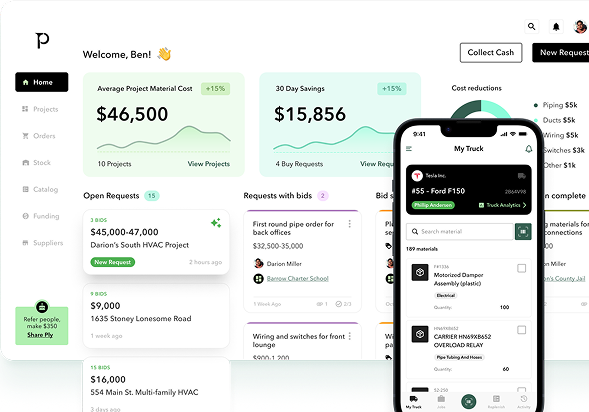
Ply

Managing and buying materials

Ply streamlines material procurement for MEP contractors with cost savings, payments, and supplier requests. Integrated with third-party fintech APIs like Plaid, Railz, Lendflow, and Stripe.

Fintech MVP Development Mobile Web SaaS MVP Development
Featured Cases
line on background

Related services

All services

Frequently Asked Questions

SaaS development services cover the full lifecycle of building a cloud-based product: discovery and requirements, architecture design, frontend and backend development, multi-tenant infrastructure setup, third-party integrations, QA, security testing, deployment, and post-launch support. The scope depends on where you are starting – a greenfield MVP has different deliverables than a migration from a legacy system. Estimate your project → gives a starting point for scoping. SaaS software development at Dotcode always includes code and IP ownership transfer on day one.

SaaS development services pricing depends on product complexity, number of integrations, compliance requirements, and whether you need mobile alongside web. A focused MVP with a defined scope runs in the $30k–$80k range. A multi-tenant enterprise platform with compliance documentation runs significantly higher. The most reliable way to get a number is a scoping conversation, not a quote from a webpage. Use the estimator to describe your requirements and we will come back with a realistic range. SaaS app development cost surprises almost always come from undocumented scope, not from the development work itself.

SaaS product development from discovery to a working MVP takes 6–10 weeks for a focused scope with defined requirements. A full-featured platform with multiple integrations, mobile clients, and compliance documentation runs 3–6 months. Timeline is driven more by integration complexity and compliance review cycles than by the development work itself. Custom SaaS development that skips the discovery phase and goes straight to building almost always takes longer than the estimate – the discovery cost is recovered in avoided rework.

Yes. Multi-tenancy is a core part of how we build. As a SaaS development company, we design tenant isolation at the schema or database level depending on your compliance requirements and customer data volume. Automated tenant onboarding, usage-based billing infrastructure, and per-tenant configuration are standard scope in most SaaS software development company engagements at Dotcode. If your product needs to white-label per customer, that is a separate architectural layer we have built before.

SaaS development services at Dotcode use React, Node.js, Python, and Golang on the backend, deployed on AWS, Google Cloud, or Azure with Kubernetes for orchestration. Apache Kafka and RabbitMQ for event streaming. Datadog and Prometheus for monitoring. The stack is not a default template – it is selected during the architecture phase against your product requirements. SaaS app development with the wrong stack for the use case creates performance and maintainability problems that show up six months after launch.

SaaS software development that is not designed for scale from the start creates technical debt that is expensive to address under load. Auto-scaling infrastructure, connection pooling, and caching are architecture decisions, not features you add later. On security: end-to-end encryption, MFA, and role-based access control are part of the data model. SOC 2, GDPR, and HIPAA compliance paths are scoped during discovery. Custom SaaS development that treats security as a pre-launch checklist rather than an architecture decision reliably produces incidents.

SaaS product development for migration involves moving an existing application to cloud-native, multi-tenant architecture without disrupting the current product. We use the strangler fig pattern: new functionality routes to the new architecture while legacy functionality migrates incrementally. The existing product keeps running throughout. Timeline depends on the size of the existing codebase and how tightly coupled the data model is. SaaS development company engagements for migration always start with a discovery phase that maps the current system and produces a phased migration plan before any code changes.

What Sets Us Apart

Start Your SaaS Development Journey with Dotcode

100% Code Ownership

No copy-pasting, no licensing restrictions—you own 100% of your software.

Agile & Fast Development

We adopt an Agile approach to ensure on-time and on-budget project completion.

Scalable, High-Performance SaaS Architectures

Seamless performance at any scale.

Flexible Pricing & Engagement Models

Plans that fit your needs.

Third-Party Integrations & API-First Approach

We design SaaS platforms ready to connect with CRMs, payment systems, analytics tools, and more — powered by clean, scalable APIs.

User Management, Billing & Subscription Logic

Robust role-based access control, flexible billing cycles, and Stripe-based payment flows — all built for seamless SaaS operations.

Have a vision for your SaaS product?

Tell us about your product – we’ll scope the MVP and show you what 6–10 weeks to a working version looks like.