Custom Fintech Integration Solutions

Banks, lenders and fintech integration services teams connect banking APIs, payment gateways, KYC/AML workflows, and open banking protocols into one reliable, secure architecture – without the overhead of maintaining fragile point-to-point connections.

Why Fintech Companies Need a Custom Integration Layer

Point-to-point integrations don't scale

Every new provider means another custom connection to build and maintain, turning the codebase into brittle glue code.

Manual data reconciliation

Transactions, balances, and KYC statuses fall out of sync across providers, requiring manual intervention to catch discrepancies.

Slow onboarding of new providers

Adding a new payment rail or identity verification vendor takes months of engineering time instead of days through a unified gateway.

Compliance & security gaps

Ad-hoc API connections create unmonitored attack surfaces and make PCI DSS, SOC 2, and GLBA audit compliance a nightmare.

Fintech Integration Services

Our fintech integration services cover the complete financial technology stack – from legacy core banking to modern open banking and embedded finance APIs.

01
Banking & Core Banking API Integration

Connect to core banking platforms like Temenos, Mambu, and Finastra via REST and SOAP APIs, enabling real-time account balances, fund transfers, and ledger updates without destabilizing core systems.

02
Payment Gateway Integration

Integrate payment gateways – Stripe, PayPal, Adyen, ACH, and SEPA – with automatic routing, multi-currency support, fee optimization, and resilient webhook-driven transaction lifecycle management.

03
Open Banking & Third-Party Data Integration

Implement open banking protocols (OFX, PSD2/Open Banking UK, Plaid, MX) to securely access consumer financial data, bank feeds, and account aggregation services with granular consent management.

04
KYC/AML & Identity Verification Integration

Integrate automated identity verification, document validation, and sanctions screening (Onfido, Persona, Trulioo, Jumio) into onboarding flows with real-time risk scoring and automated compliance logging.

05
Embedded Finance Integration

Enable non-financial platforms to offer lending, bank accounts, and card issuing through BaaS (Banking-as-a-Service) providers like Unit, Treasury Prime, and Marqeta via modular, white-label API layers.

06
Legacy System & Core Banking Modernization

Wrap legacy banking software in modern API abstractions, creating microservices-based middleware that allows modern frontends and third-party tools to interact with legacy backends safely.

Core Features of Fintech Integration Solutions

Every fintech platform integration services project ends up needing some version of these six pieces – the mix depends on how many providers you’re already running.

1

Unified API Gateway Across Providers

Single abstracted endpoint layer so your core application interacts with one unified data format, regardless of how many payment or banking providers sit behind it. Business result: swapping or adding providers requires zero frontend changes.

2

Real-Time Transaction & Balance Sync

Webhook-driven architecture and polling workers ensure account balances and transaction states synchronize across internal databases and external providers with sub-second latency. Business result: elimination of double-spend and balance discrepancy errors.

3

Automated KYC/AML Verification Flow

Multi-vendor fallback routing for identity checks and sanctions lists, automatically escalating flagged cases to human review queues. Business result: onboarding pass rates increase while maintaining 100% regulatory compliance.

4

Payment Gateway Orchestration

Smart routing between multiple payment processors based on cost, geographic region, and provider availability, with automatic failover on gateway downtime. Business result: lower transaction fees and near-zero checkout drop-off due to processor outages.

5

Error Handling & Data Reconciliation Layer

Automated end-of-day reconciliation engines that match ledger records against external bank and processor feeds, isolating mismatched transactions for rapid resolution. Business result: manual reconciliation workload reduced by 90%+.

6

Compliance & Audit Logging

Immutable, tamper-evident audit logs of every API call, payload hash, and data transformation, meeting PCI DSS, SOC 2 Type II, and GLBA standards out of the box. Business result: painless audits and instant regulatory compliance reporting.

line on background
square on background

Who We Work With

From emerging fintech startups to established commercial lenders, we build integration infrastructure that handles financial data safely and reliably.

1
Banks & Credit Unions

Connecting legacy core systems with modern digital banking apps, third-party payment rails, and open banking protocols without disrupting daily operations.

2
Digital Lenders & Payment Platforms

Integrating credit scoring, automated underwriting APIs, loan servicing systems, and real-time payment rails to accelerate decision-to-fund cycles.

3
Fintech Startups

Building end-to-end integration architecture from scratch: connecting BaaS providers, payment rails, KYC vendors, and cloud ledgers for rapid time-to-market.

4
Embedded Finance & SaaS Companies

Embedding lending, bank accounts, and card issuing into existing non-financial software products via secure, developer-friendly APIs.

5
Wealth & Investment Platforms

Integrating market data feeds, brokerage APIs, custodian integrations, and automated portfolio rebalancing tools with high-throughput data pipelines.

6
InsurTech & Insurance-Adjacent Companies

Connecting premium payment processors, claims automation systems, policy administration engines, and carrier APIs for seamless customer journeys.

CUSTOM VS MIDDLEWARE

Custom Fintech Integration vs Off-the-Shelf Middleware

Pre-built middleware platforms claim to solve fintech integration overnight, but their standardized models fall apart when faced with complex reconciliation and custom business logic. Here is how custom fintech integration compares:

Data Model Flexibility
Off-the-shelf middleware / iPaaS

Forced into the vendor’s rigid canonical schema

Custom by Dotcode

Designed 100% around your proprietary data model

Reconciliation Logic
Off-the-shelf middleware / iPaaS

Basic status matching; complex logic requires brittle workarounds

Custom by Dotcode

Custom automated reconciliation pipelines with edge-case handling

Vendor Dependency
Off-the-shelf middleware / iPaaS

Recurring monthly platform fees scaling with volume; locked in

Custom by Dotcode

Zero platform licensing fees; 100% code ownership

Compliance & Security
Off-the-shelf middleware / iPaaS

Shared multi-tenant infrastructure; compliance depends on vendor

Custom by Dotcode

Dedicated infrastructure in your cloud; direct SOC 2 / PCI DSS audit trail

Latency & Performance
Off-the-shelf middleware / iPaaS

Extra network hops through middleware proxy servers

Custom by Dotcode

Direct, optimized API connections engineered for sub-second responses

Provider Support
Off-the-shelf middleware / iPaaS

Limited to pre-built marketplace connectors; unsupported APIs blocked

Custom by Dotcode

Integration with any REST, SOAP, ISO 20022, or custom proprietary API

Stuck stitching together five different fintech APIs by hand?

Let’s build a unified integration layer that scales with your transaction volume.

Book a call

Development Process

Here’s how a typical fintech integration services project runs, start to finish:

1

Discovery & Provider Mapping

We map all upstream and downstream APIs, payload formats, authentication schemes, and compliance constraints before writing code.

2

Integration Architecture Design

We design a decoupled gateway layer with message queuing, rate-limiting, error retries, and data encryption architecture.

3

API & Security Layer Development

Engineers build the connectors, token management, mutual TLS, HMAC authentication, and payload transformation pipelines.

4

Agile Development

Development runs in 2-week sprints with regular sandbox demos, so you test real transaction flows against mock and sandbox environments early.

5

Compliance & Reconciliation Testing

Every flow undergoes negative testing, network failure simulation, reconciliation audit verification, and penetration testing.

6

Launch & Post-Launch Support

Cutover planning, canary deployments, 24/7 go-live monitoring, and continuous post-launch support as provider APIs evolve.

Tech Stack

The stack behind our fintech integration services is chosen for reliability under transaction load first, everything else second.

Every project run by our fintech api integration company team draws from this same stack, adjusted to the providers you’re already committed to.

Need help selecting the right stack?

Let’s talk!

Nazar Solovei
Nazar Solovei Business Development Manager
Let’s talk
Backend
Backend

Node.js, Python, Java, .NET

Cloud
Cloud

AWS, Google Cloud, Azure

Banking/Core
Banking/Core

Temenos, Mambu, Finastra APIs

Payments
Payments

Plaid, Stripe, ACH/Zelle, SWIFT

Databases
Databases

PostgreSQL, Redis

Compliance & Security

PCI DSS, SOC 2, OAuth 2.0, TLS 1.3

Need help selecting the right stack?

Let’s talk!

Nazar Solovei
Nazar Solovei Business Development Manager
Case Study

Case Study: Ply

All cases

Ply

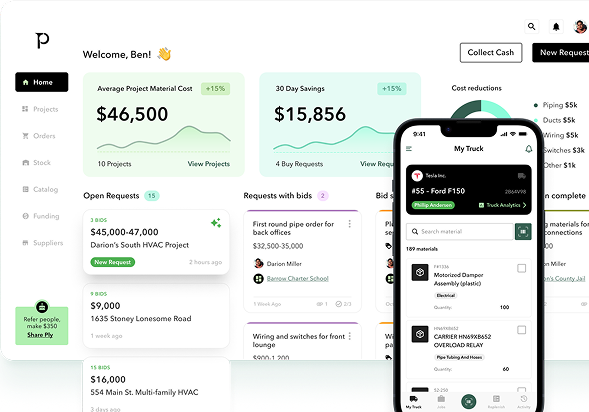
Materials procurement platform for MEP contractors

Client: Ply – a procurement platform for MEP contractors.

Challenge: MEP contractors were managing material procurement, supplier requests and payments across disconnected tools, with no unified view of project costs or approvals.

Solution: Dotcode built Ply’s procurement and payment infrastructure integrated with third-party fintech APIs – Plaid, Railz, Lendflow and Stripe – so material requests, supplier bids and payments run through one connected flow instead of separate systems.

Result: Ply’s team gets a live view of project material costs, savings and open requests in one dashboard, with financing and payment data flowing directly from the integrated fintech providers instead of manual entry.

Fintech Procurement API Integration Web Platform
Case Study

Why Businesses Choose Dotcode

Exact Data Model Fit

Fintech integration built around your exact data model and provider stack – not generic middleware.

Compliance from Day One

PCI DSS and SOC 2 compliance built into the architecture from day one – not retrofitted before an audit.

Post-Payment Model

Post-payment model – no upfront financial risk. You pay for delivered, tested software.

Full IP Ownership

100% code and data ownership from day one. No vendor lock-in.

Full-Cycle Delivery

Full-cycle delivery: discovery, architecture, integration development, QA, compliance review, launch, post-launch support.

Frequently Asked Questions

It’s connecting your product to the banking, payment, identity and data providers it depends on, through one architecture instead of separate one-off connections. Fintech integration services typically cover core banking APIs, payment gateways, KYC/AML and open banking data. Most fintech integration solutions combine several of these, depending on which providers your product already relies on.

Core banking (Temenos, Mambu, Finastra), payment gateways (Stripe, Plaid, ACH, SWIFT), and identity/KYC providers for onboarding and sanctions screening. Our fintech api integration services aren’t locked to a fixed provider list – banking api integration services get scoped around whatever your product already connects to, or plans to.

A single provider integration – one payment gateway, for example – can take a few weeks. Full custom fintech integration across banking, payments and KYC runs longer. Most fintech system integration services projects get a real timeline only after mapping your exact provider list and data model.

Cost depends on how many providers you’re connecting and how complex the reconciliation logic needs to be. Fintech integration services for a single gateway cost far less than a full multi-provider gateway layer. If you’d rather talk it through first, that’s exactly what our fintech integration consulting sessions are for.

In most cases, yes. Our core banking integration services cover the major platforms – Temenos, Mambu, Finastra – plus custom or regional providers when needed. If your provider isn’t on our standard list, fintech platform integration services still apply; it just means a discovery call to confirm what their API actually supports.

Yes. Every project our fintech integration company delivers builds PCI DSS and SOC 2 requirements into the architecture from the start – encryption, access controls and audit logging aren’t a separate phase. As a financial services integration company, that’s the baseline we design to, not an upsell.

Yes. Our kyc aml integration services cover identity verification, document checks and sanctions screening, and our open banking integration services handle account aggregation and financial data sharing across the providers your users actually bank with.

Ready to connect your platform to the fintech providers you actually need?

Let’s build a secure, scalable integration layer that fits how your fintech platform operates. Contact us or get a free estimate today.