


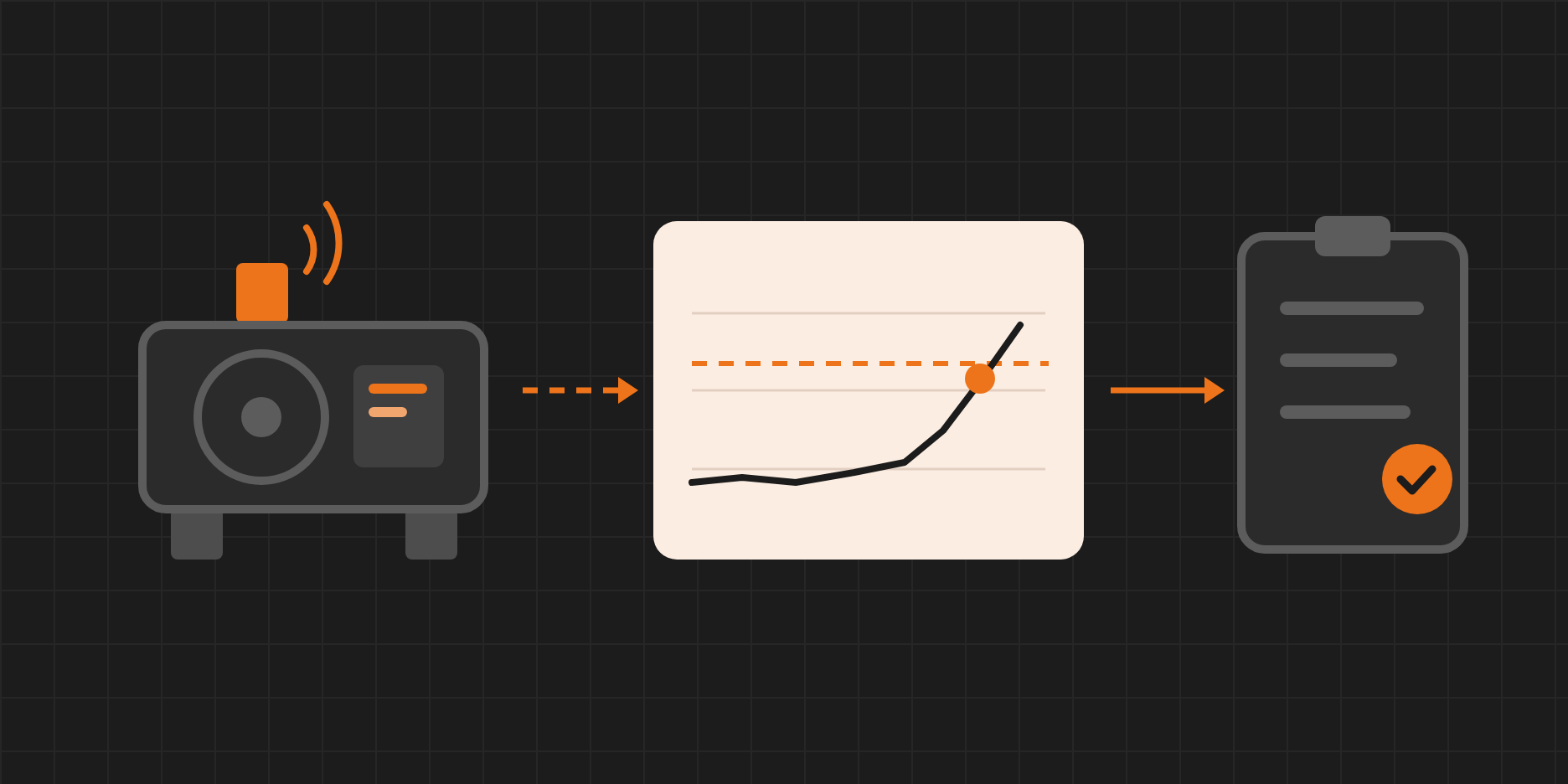
- IoT predictive maintenance uses sensors on machines, a data pipeline and models to estimate when equipment is likely to need service, so work can be planned before a breakdown.
- Outputs indicate developing risk or unusual behavior, not a guaranteed failure time, and depend on data quality and validation.
- Start with one critical asset, one failure mode and a clear success metric rather than a large platform.
What Is IoT Predictive Maintenance?
IoT predictive maintenance, short for internet of things predictive maintenance, is a maintenance approach in which sensors on machines collect condition data, such as vibration, temperature or electrical current, and software analyzes it to estimate when a component is likely to fail. Maintenance teams then plan work based on the actual condition of the equipment rather than a fixed calendar or a breakdown.
IoT and predictive maintenance fit together because predictions need a steady flow of data from the machines. Manual inspection rounds provide snapshots of machine condition; connected sensors can provide measurements between inspections, helping teams detect changes before the next scheduled round.
It is important to be clear about what the output is. A model does not know when a machine will fail. Depending on the method, it flags a measurement outside agreed limits, a trend toward a limit or behavior that differs from normal. Some models also estimate the likelihood of a problem, and the quality of any such estimate depends on the data and on how it was validated. Good programs treat an alert as a reason to inspect, not as a verdict.
The term IoT maintenance is sometimes used for maintaining connected devices themselves; in this article it means maintaining machines with the help of connected sensors. Predictive maintenance and IoT projects often start with off-the-shelf sensor kits and a vendor dashboard. Teams that outgrow those kits, for example when they need to combine several machine types, their own data and their maintenance systems, often move to custom IoT development that connects the whole chain from sensor to work order.
Predictive vs Preventive vs Reactive Maintenance
Most plants use a mix of maintenance strategies, and predictive maintenance does not replace the others. A typical site combines reactive repairs, preventive maintenance, IoT condition monitoring and predictive models, choosing the approach asset by asset. It adds a data-driven trigger for the assets where failures are costly and give warning signs in advance.
IoT-enabled preventive maintenance often starts with simple usage triggers: a counter of operating hours or cycles replaces a calendar date. Condition-based maintenance uses observed equipment condition to decide when intervention is needed, often through thresholds such as vibration above an agreed limit. Predictive maintenance goes further and uses trends and models to estimate where the condition is heading. IoT preventive maintenance and condition monitoring are often the right first stages, and many assets never need more than that. The terms overlap: predictive maintenance is often treated as a form of condition-based maintenance that uses forecasts of future condition. Here, the table distinguishes threshold-triggered actions from forecast-driven planning.
The choice is made per asset, not per plant. A simple criticality review helps: what does an hour of downtime on this machine cost, how long does a repair take, is there a spare, and does the failure give warning signs that a sensor can measure? Assess safety, environmental and regulatory consequences alongside production losses. Use predictive maintenance where a detectable warning gives enough time to act. For other assets, choose preventive maintenance, protective measures or an explicitly justified run-to-failure strategy.
| Approach | Trigger | Strength | Weakness | Example |
|---|---|---|---|---|
| Reactive | Breakdown | No upfront monitoring cost | Unplanned stops, secondary damage, rush repairs | Replace a light fitting when it fails |
| Preventive | Calendar or usage (hours, cycles) | Simple to plan | Parts replaced too early or too late | Change gearbox oil after a set number of operating hours |
| Condition-based | Observed condition indicates a need for intervention, often through thresholds | Acts on actual condition | Threshold may trigger late or too often | Inspect a pump when vibration exceeds the agreed limit |
| Predictive | Trend or model estimates developing failure | Earlier warning, planned intervention | Needs data, models and people to act on alerts | Plan a bearing replacement when the vibration trend shows wear |
How IoT Predictive Maintenance Works: From Sensor to Work Order
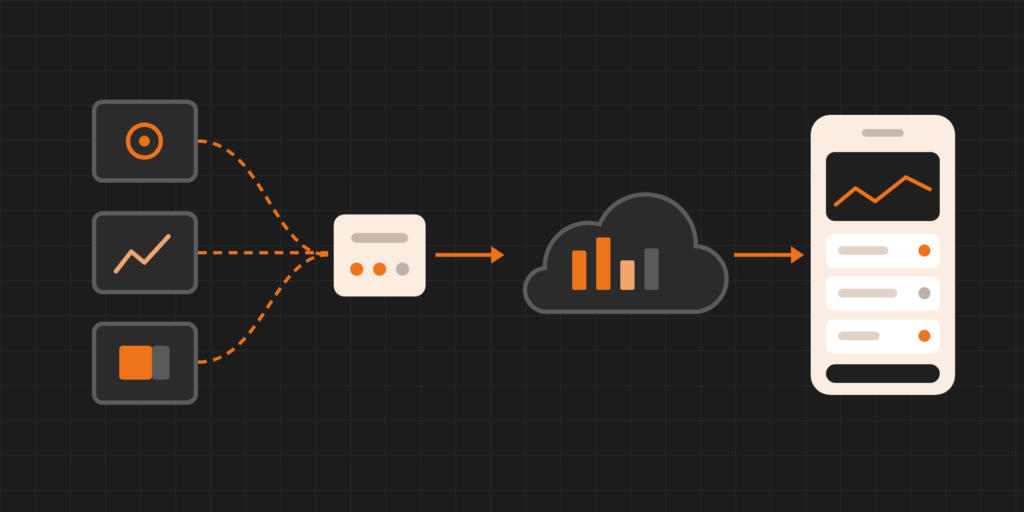
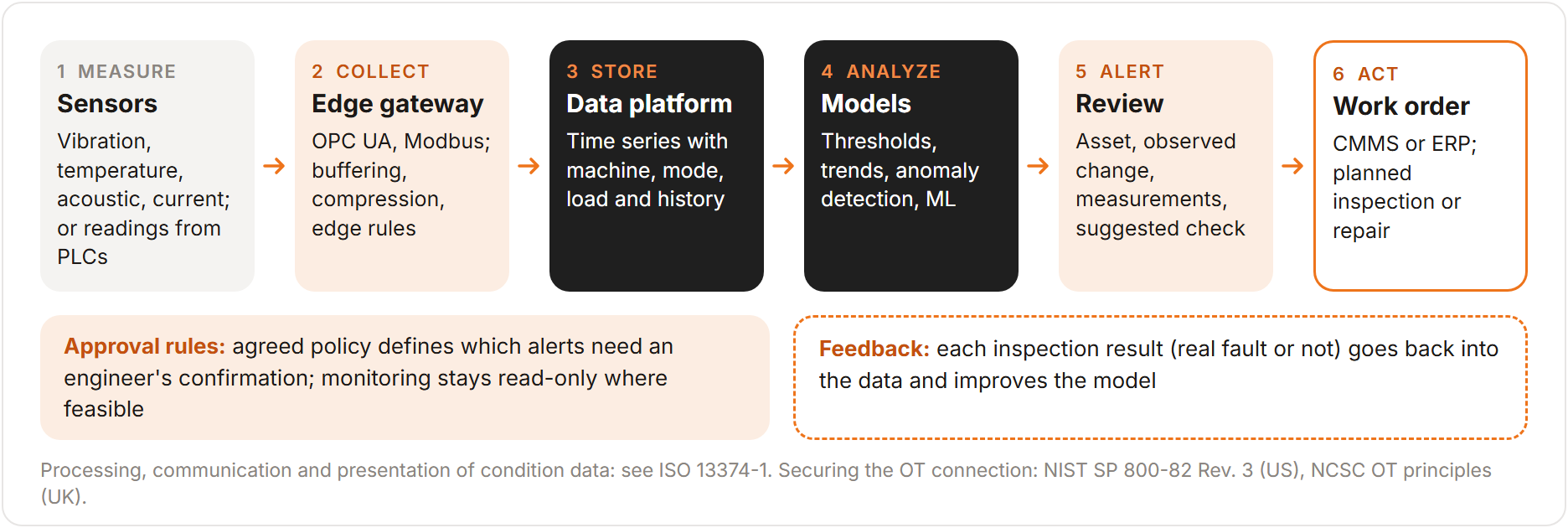
A predictive maintenance IoT system has several parts that must work together. Predictive maintenance with IoT follows a chain: sensors measure the machine, data travels through a gateway to storage, models turn data into alerts, and alerts become maintenance work. ISO 13374-1 gives general guidelines for software that processes, communicates and presents machine condition monitoring and diagnostic information, which is a useful reference when designing this chain.
Sensors
The sensor depends on the failure mode you want to catch. Vibration sensors are the most common choice for rotating equipment such as motors, pumps, fans and gearboxes, because bearing wear, imbalance and misalignment change the vibration pattern. Temperature sensors catch overheating in bearings, motors and electrical cabinets. Acoustic and ultrasonic sensors pick up leaks and early friction. Electrical current sensors show changes in motor load. In an IoT based predictive maintenance setup, these sensors may be added to the machine or the data may come from controllers that already measure it.
For vibration, ISO 20816-1 sets general principles for measuring and evaluating machine vibration, with criteria based on both vibration magnitude and change of vibration. The second edition was published in October 2026 and replaced the 2016 edition, so check which edition your vibration criteria and vendor documentation refer to. Part 1 provides general guidance; use the applicable machine-specific part and manufacturer requirements when selecting evaluation criteria and operating limits.
Connectivity and edge
Machines often expose data through industrial interfaces such as OPC UA or Modbus TCP. An edge gateway reads the required measurements, buffers them locally and forwards selected data to the analytics platform. High-frequency vibration data is large, so the gateway may calculate features or compress data before sending it, which keeps the uplink usable. Some alerts can also run on the edge, so they do not depend on the cloud connection.
Data platform and storage
The data platform stores time-series readings together with context: which machine, which sensor, operating mode, load and maintenance history. Without context, a model cannot tell a fault from a normal change, such as a machine running a heavier product. Plan retention: raw high-frequency data is expensive to keep, but some of it is needed to investigate alerts and retrain models.
Models and alerts
Models range from simple thresholds and trend rules to statistical anomaly detection and machine learning. Each alert should identify the asset, the observed change, the supporting measurements and the recommended check. If the system reports a probability or confidence estimate, explain what it represents and how it was validated. Operators and engineers see this in dashboards and notifications built through IoT application development. Alert delivery should not depend on a single channel, and the escalation path should match how critical the asset is.
Integration with CMMS, ERP and work orders
An alert creates value only when someone acts on it. Connect the system to the computerized maintenance management system (CMMS) or ERP through API integration, so a confirmed alert becomes a work order with the asset, the finding and the suggested action. Define which alerts require human approval and which routine workflow actions may be automated under an agreed policy. Prefer read-only monitoring connections where feasible, and keep analytics separate from machine protection and safety functions. Define approval rules for maintenance actions and any changes to machine settings. Feed the result of each inspection back into the data: whether the fault was real is the most valuable label a model can get.
What Data and Models You Need
For IoT maintenance, predictive models are only as useful as the data behind them. Data gaps, inconsistent asset records and missing operating context can undermine even a well-chosen model. Before choosing a platform or a predictive maintenance model, check that the basics are in place.
- An asset and a failure mode. Pick one critical machine and one failure that is costly, happens often enough and gives warning signs, such as bearing wear on a pump.
- Sensors matched to the failure mode. Vibration for bearing wear, temperature for overheating, current for load changes. The sampling rate must be high enough to capture the signal.
- A baseline period. Weeks or months of data under normal operation, across the usual operating modes, so the system learns what normal looks like.
- Maintenance history. Work orders, inspection notes and recorded failures, linked to the same asset IDs as the sensor data.
- Context data. Operating mode, speed, load and product, so a change in conditions is not mistaken for a fault.
- People who act on alerts. A named owner for each alert type and time to inspect.
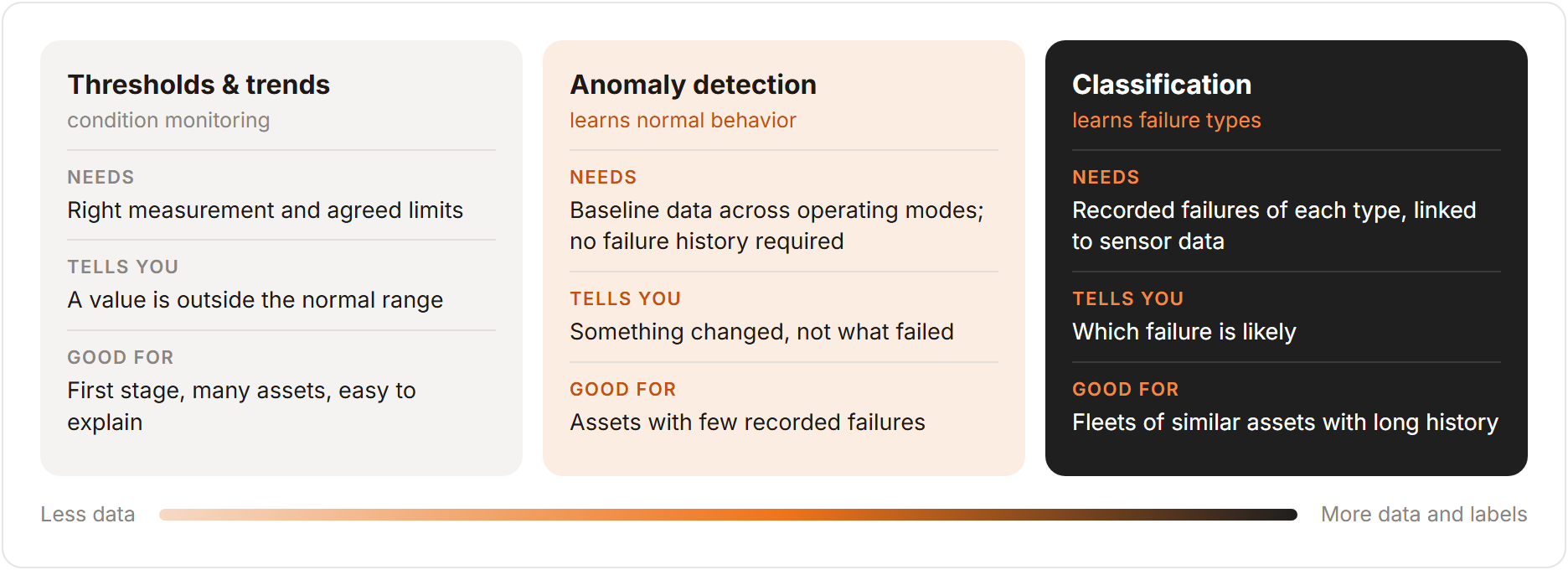
The choice of model follows from the data. Classification models, which learn to recognize specific failure types, need recorded failures of each type to learn from, and many plants have only a few. Anomaly detection learns normal behavior and flags deviations, so it can start without a failure history, but it says that something changed rather than what failed. Thresholds and trend rules work well for many assets and are easier to explain to technicians.
ISO 17359 gives general guidelines for setting up a condition monitoring programme for any type of machine. Under such a programme, thresholds on well-chosen measurements are often enough for a first stage. Machine learning becomes worth it when there are many similar assets, enough history and patterns that simple rules miss. Our AI integration glossary entry explains how models are connected to existing business systems.
Standards and Security That Apply
The documents below provide technical standards and security guidance. Applicable legal duties and contractual requirements must be assessed separately for the site, sector and deployment. The standards give a shared vocabulary and a structure for the program, and they help when you compare vendors. Connecting machines to networks also brings security guidance into scope.
| Standard or guidance | What it covers | How it affects the project |
|---|---|---|
| ISO 17359:2018 | General guidelines for setting up a machine condition monitoring programme; applies to all machines | Structure for choosing assets, measurements, alert criteria and review |
| ISO 13374-1:2003 | General guidelines for software that processes, communicates and presents condition monitoring and diagnostic information | Reference for the data chain from sensor to decision and for data exchange between tools |
| ISO 20816-1:2026 | General principles for measuring and evaluating machine vibration (second edition, October 2026) | Vibration measurement and evaluation criteria; check which edition vendors use |
| NIST SP 800-82 Rev. 3 (US) | Guide to operational technology (OT) security, including industrial control systems | Network segmentation, access control and monitoring when machines and controllers connect to IT and cloud |
| NCSC secure connectivity principles for OT (UK) | Eight principles for connecting OT systems, from limiting exposure to logging and an isolation plan | Design of the gateway and remote connections; how to isolate OT if something goes wrong |
NIST SP 800-82 Rev. 3 was published in September 2023 and covers how to secure OT while addressing its performance, reliability and safety requirements. NIST has released an initial public draft of Revision 4, with comments due by 30 November 2026, so check the status before relying on a specific section; the draft does not yet replace Rev. 3. In the UK, the NCSC's secure connectivity principles for operational technology name predictive maintenance among the benefits of connected OT and set out principles for managing the risks that come with it. The NCSC presents the eight principles as design goals rather than a minimum compliance checklist.
In practice, the standards help most at two points. During planning, ISO 17359 gives a checklist for choosing assets, measurements and review steps, so the program does not grow sensor by sensor without a plan. During design, the OT security guidance shapes the network: where the gateway sits, which direction data flows, how remote access is controlled and logged, and what happens if the connection to the cloud must be cut.
Using these documents does not make a system compliant or certified. They are a checklist for design decisions: which data leaves the plant, through which connection, and who can send anything back to the machines.
What the Savings Numbers Really Say
Articles about predictive maintenance often quote percentages for less downtime, lower maintenance costs or higher uptime. Many of these figures trace back to vendor case studies, commissioned studies based on composite organizations or consultancy analyses that do not publish their sample or method. They may be true for the projects they describe, but they are not benchmarks for your plant.
One widely cited figure has a published method. Siemens estimates in its report The True Cost of Downtime 2024 that unplanned downtime costs the Fortune Global 500 about $1.4 trillion a year, about 11% of their revenues. The figure is an extrapolation from 181 interviews in four sectors, and Siemens sells predictive maintenance software, so read it as an indication of scale rather than a measured total.
When a vendor quotes a result, ask three questions. What was the baseline, measured how and over what period? Which customer, asset type and failure mode does the number come from? Was the result measured by the customer or calculated by the vendor? A useful business case for your plant uses your own downtime records, the cost of an hour of lost production and the cost of the repairs you want to avoid.
Start with the unplanned downtime attributable to the selected failure mode, then estimate what share the proposed monitoring and maintenance response could realistically prevent. Multiply the expected avoided hours by the incremental cost of downtime, and add any repair savings without double-counting costs. Compare these benefits with installation and operating costs, including inspections, false alarms and any additional planned stops. Test conservative, expected and optimistic scenarios.
Predictive maintenance is not worth it for every asset. If a machine is cheap to replace, has a spare on standby, fails without warning signs or causes little disruption when it stops, preventive or even reactive maintenance may cost less.
Where It Works: Use Cases by Industry
IoT in predictive maintenance works best on rotating and thermal equipment with costly failures. One concrete asset per industry shows the pattern.
Manufacturing
A typical first asset is a motor and bearing assembly on a production line. Vibration sensors can show bearing wear before it stops the line, and the alert is planned into the next scheduled stop rather than causing an unplanned one.
Energy and utilities
Pumps in water networks and transformers in power distribution are common candidates. Pump monitoring tracks vibration and motor current; transformer monitoring tracks temperature and load. Sites are spread out, so connectivity and edge processing need as much planning as the models.
Fleet and logistics
For vehicles and refrigerated units, engine and compressor data from on-board systems can show developing faults, so a vehicle is serviced at the depot instead of breaking down on the road. For refrigerated transport, compressor behavior and temperature trends can flag a unit that struggles to hold its set point before the cargo is at risk. The challenge is intermittent connectivity, which makes buffering and edge rules important.
In agriculture, the same approach applies to farm equipment such as irrigation pumps and tractors; our article on IoT in smart agriculture covers how farms use connected sensors.
Common Challenges
Most problems in predictive maintenance projects are not about models. They come from data, connectivity and the way people work with alerts. The table lists the issues we see most often and one practical mitigation for each.
| Challenge | Why it happens | Mitigation |
|---|---|---|
| Data quality and gaps | Sensors drop out, timestamps drift, readings lack context | Monitor data quality as closely as machine health; store operating context with readings |
| Too few failure events | Critical machines rarely fail, so there is little to learn from | Start with thresholds and anomaly detection; record every inspection result as a label |
| False alerts and alert fatigue | Thresholds set too tight, operating changes treated as faults | Tune alerts with technicians, include supporting measurements and operating context, and review alert outcomes monthly |
| Legacy machines without sensors | Older equipment has no digital interface | Retrofit external sensors or read existing controllers through a gateway |
| Connecting to maintenance systems | Alerts live in a separate dashboard that no one checks | Create work orders in the CMMS or ERP through an API, with human review |
| OT security | New connections expose machines that were never designed for networks | Segment networks, limit and log remote access, follow NIST SP 800-82 or NCSC principles |
| People and process | No one owns alerts or has time to act | Name an owner per alert type, define response times and report results to management |
How to Start: Pilot, Build or Buy
Predictive maintenance using IoT is easiest to start small. A pilot proves that the data, the alerts and the people work together before you scale.
- Choose one asset and one failure mode where downtime is costly and the failure gives warning signs.
- Define the success metrics before the pilot, such as data completeness, alert precision and warning time, and record the current baseline for downtime and emergency repairs.
- Time-box the pilot and agree what result justifies the next stage.
- Plan the response: who receives alerts, how they inspect and how results are recorded.
A short pilot can validate data collection, alert delivery and maintenance workflows without proving a reduction in failures. Evaluate alerts against inspection findings and historical events where available, using time-separated test data. Track false alerts per asset, missed known events and whether warning time is long enough to arrange an intervention. If too few failure events occur, report the evidence as inconclusive rather than claiming a downtime reduction.
At the end of the pilot, you should have more than a dashboard: a record of alerts and what inspections found, the share of alerts confirmed by inspection, the data quality issues you hit and an estimate of the effort needed to add similar assets. That evidence decides whether to scale, change the approach or stop.
Scaling is a separate step. Adding assets brings new machine types, more data and more alerts, so plan device management, data retention, alert routing and OT security for the target size before rolling out.
Buying a vendor product makes sense when your machines are standard, the vendor supports your sensors and protocols, and its dashboard and alerts fit how your team works. A custom build makes sense when you need to combine several machine types and data sources, connect to your own maintenance and ERP systems, keep data in your own environment or build the capability into your own product. Many companies combine both: vendor sensors and gateways with their own data platform and applications. When the whole chain needs to work as one system, a custom build can cover sensors, connectivity, the data pipeline and the apps. Agree on code ownership, repository access and handover terms in the contract.
FAQ
Yes, in many cases. External sensors for vibration, temperature or current can be mounted on older motors, pumps and gearboxes without changing the control system, and a gateway sends the data on.
Where the machine has a controller, existing measurements can often be read through industrial protocols such as Modbus or OPC UA. Check the mounting points, power and network access on site before choosing sensors, and plan security for every new connection.
Condition-based maintenance triggers work when the observed condition indicates a need for intervention, often when a measured value crosses a threshold, such as vibration above an agreed limit. Predictive maintenance uses trends and models to forecast where the condition is heading, which can give earlier warning.
The terms overlap, and predictive maintenance is often described as a form of condition-based maintenance. Threshold-based monitoring is simpler and often the right first step. Predictive maintenance adds value when there is enough data and the cost of failures justifies the extra work on models and alert tuning.
Maintenance or reliability engineering should own the outcome, because they decide which assets matter and act on alerts. IT and OT teams own the data platform, connectivity and security.
In practice, a small joint team works best: a maintenance lead, a data or software engineer and someone responsible for OT security. Agree on who changes alert thresholds and who approves new connections to the machines.
It depends on scope. For custom IoT projects, Dotcode's planning range is roughly two to three months for a proof of concept on a few devices and six to twelve months for a production-ready system, though scope can move these numbers a lot. These are delivery estimates, not guarantees that enough failure events will occur to validate predictive performance.
The main cost drivers are the number and type of machines, sensors and their installation, connectivity on site, integration with maintenance and ERP systems, the data platform and the time engineers spend reviewing alerts. The estimator gives an initial development estimate.
Not always. Many programs start with thresholds and trend rules on well-chosen measurements, which are easier to explain and maintain, and work well for common failure modes such as bearing wear or overheating.
Anomaly detection and machine learning add value when you monitor many similar assets, have enough history across operating modes and see patterns that simple rules miss. Start with the simplest approach that catches the failure early enough to act.
Next Step
Planning an IoT initiative and want a clear roadmap before you commit budget? Our IoT development consulting helps you choose the first assets, the architecture and the business case before development starts.