





Logistics IoT
Logistics IoT Development Services
Our logistics IoT development services connect tracker and sensor data to your TMS, WMS or ERP, so dispatchers act on exceptions from the shipment record.
- Last reported location
- Age of each reading
- Trackers from several vendors
- TMS, WMS, ERP sync
5.0 on Clutch35 reviews
100%Upwork job success
Since 2017offices in New York and London
Why Logistics IoT Projects Lose Visibility After the Pilot
Tracking Data Sits in Separate Vendor Portals
Each tracker vendor ships its own portal, which is often why operators turn to a logistics IoT development company. Dispatchers keep five tabs open and still call the driver to learn where the pallet is.
TMS and WMS Never See the Live Signals
Location and condition data stay in the IoT layer, while orders, routes and stock live in the TMS and WMS. Planners make decisions on yesterday's status, and customers get estimates that do not match reality.
Alerts Arrive After the Cargo Is Damaged
A temperature excursion shows up in a report the next morning. By then the team can only investigate what happened instead of checking the load while there was still time to act.
Trackers Reconnect at the Same Time
After a zone without coverage, dozens of devices send their stored messages at once. A backend built for a small pilot puts fresh events in the same queue, and dispatch sees new alerts late.
Services
Logistics IoT Development Services We Provide
Logistics IoT Architecture and Discovery
As a logistics IoT development company, we list your devices, vendors and existing systems, design the data model and choose the connectivity. We also decide which parts can stay on vendor platforms and which need custom software. You get an architecture document and a pilot plan.
Device Connectivity and Data Ingestion
Trackers reach the cloud over cellular, LoRaWAN or Wi-Fi. We collect their readings from supported vendor APIs, MQTT connections or LoRaWAN network servers and map them to a common event format, so you keep the hardware you already run.
Event Processing and Alert Rules
Every message passes through rules you define: temperature range, geofence, door status, idle time. When a rule fires, the right person gets an alert and the event is logged with the shipment, so nothing depends on someone watching a screen.
Dispatcher Dashboards and Driver Mobile Apps
Drivers use the mobile app to confirm a pickup, scan a pallet or report a delivery issue, and dispatchers see the update against the shipment on a live web dashboard. More on our IoT app development.
TMS, WMS and ERP Integration
Our logistics IoT integration services sync device events with the systems you already run through APIs. Shipments, stock and invoices update from real signals, supported by our data integration and real-time data processing practice.
Analytics, Forecasting and Post-Launch Support
We turn device history into reports: planned versus actual arrival times, routes with repeated delays and ETA accuracy on completed trips. After launch, we monitor the system on cloud infrastructure for IoT data and keep improving it.
From several tracker vendors to one shipment record
Many devices, one data flow
Devices
GPS trackers, vendor A
Telematics, vendor B
Temperature sensors
Integration layerOne data flow
Common event formatLate and repeated messagesAlert rules
Your team and systems
Dispatcher dashboard
Driver mobile app
TMS, WMS, ERP
Shipment and Fleet Tracking
In IoT development for logistics, tracking comes first: trackers send location and status at set intervals. The software links each vehicle's position to the shipments assigned to it, compares progress with the planned route and updates the shipment status and ETA in the TMS.
Cold Chain Condition Monitoring
A reefer trailer sends temperature every few minutes. When it leaves the allowed range, dispatch gets an alert, and the shipment record shows the full log with any connection gaps marked.
Warehouse and Asset Tracking
Tags and scans on pallets, containers and equipment record where each item was last seen. The WMS shows the last recorded zone or scan point, so staff spend less time searching for misplaced pallets.
Vehicle and Equipment Maintenance
Mileage and operating hours flow into one history and drive the service schedule. Where diagnostic data is available, the system flags changes for the maintenance team to investigate.
Who we work with
Who We Build Logistics IoT Software For
Freight Carriers and Fleet Operators
You run trackers from several vendors and need one dashboard and live data in your TMS. We connect all devices into one view and one data flow.
3PL Providers and Warehouse Operators
Your assets and inventory are not connected to the WMS. We link tags and sensors with stock records, so the WMS shows each asset's last recorded zone.
Cold Chain Shippers
You need condition data for every shipment and reports for customers and auditors. We build monitoring, alerts and ready-to-share temperature logs.
Hardware and Telematics Vendors
Your devices work, but customers need a platform. We build the cloud and apps around your hardware, as in our IoT product development services.
How to choose
Ready-Made Tracking Platform or Custom Logistics IoT Software: How to Choose
| Criteria | Vendor tracking or telematics platform | Managed cloud IoT service (AWS IoT Core, Azure IoT Hub) | Custom integration layer and apps |
|---|---|---|---|
| What you get | Maps and reports for supported devices |
Device connectivity and messaging at scale |
One data flow, dashboards and apps for all your devices |
| One view across several vendors | Depends on supported trackers, OEM feeds and third-party integrations |
Possible, logic built by your team |
Built in from the start |
| Integration with TMS, WMS, ERP | Through the vendor's connectors, if available |
Built by your team |
Built around your systems and processes |
| Cost as the fleet grows | Per-device or subscription pricing, depending on the vendor |
Usage-based cloud fees |
Development, hosting, monitoring, support and any continuing device or vendor API fees |
| Control over data | Access, export options and retention depend on the provider and plan |
Data in your cloud account |
Full control over the data model and storage |
| Best fit | Fleets whose trackers and workflows the platform already covers |
Teams with in-house engineers |
Existing platforms leave gaps in device coverage, shipment workflows or integration with your systems |
What to consider
The right setup depends on how many device vendors you use and how deeply the data must reach your own systems.
If your platform already accepts all your trackers, you may only need its integration with the TMS, and our logistics IoT solutions development services can start exactly there.
Custom software makes sense when
- You combine trackers from several vendors.
- You need live data in your TMS, WMS or ERP.
- You want your own customer-facing tracking.
Process
How a Logistics IoT Project Runs, Step by Step
-
Discovery and systems audit
We map your devices, vendors, data and systems.You get: Map of devices, data and systems, and the target architecture Owner: Solution architect, tech lead Duration: 2-3 weeks
-
Pilot plan and architecture
We choose the route, vehicle group or warehouse for the pilot and define success criteria, following our MVP development practice.You get: Pilot scope and plan Owner: Tech lead, project manager Duration: 1-2 weeks
-
Proof of concept
Trackers from your current vendor send data through the cloud to a test dashboard and a test TMS record.You get: Working demo and a list of data gaps Owner: Backend engineer Duration: 3-5 weeks
-
Pilot with live operations
We follow one shipment on a pilot route, match tracker events to its test TMS record and check how late or repeated messages appear to dispatch.You get: A pilot report showing which events matched, how long updates took and what needs fixing before rollout Owner: QA engineer, project manager Duration: 6-10 weeks
-
Integration, rollout and support
We connect the TMS, WMS or ERP, release to production and set up monitoring.You get: Production system and a support plan Owner: Tech lead, support team Duration: 4-8 weeks, then ongoing
Cost and timeline
Logistics IoT Development Cost and Timeline
The budget is shaped by six factors:
- 1The number of vehicles, devices and sites
- 2Device vendors and protocols
- 3Connectivity (cellular, LoRaWAN or Wi-Fi)
- 4The number of integrations with TMS, WMS, ERP and carrier APIs
- 5Data volume and the alert speed you need
- 6Reporting and compliance requirements
After launch, running costs include cloud hosting, connectivity per device and support. We estimate them together with the build, so the total cost of ownership is clear before you start. For a first figure, get an IoT project estimate in our estimator as a rough guide.
Proof of concept
Demo on test data from your current devices
Typical timeline: 4-6 weeks
Pilot on one route or site
Dashboards, alert rules, live TMS or WMS link for one workflow
Typical timeline: 2-3 months
Production rollout
Whole fleet or network, all integrations, support
Typical timeline: 4-6 months
Logistics IoT projects start from$25,000
Get an IoT estimate
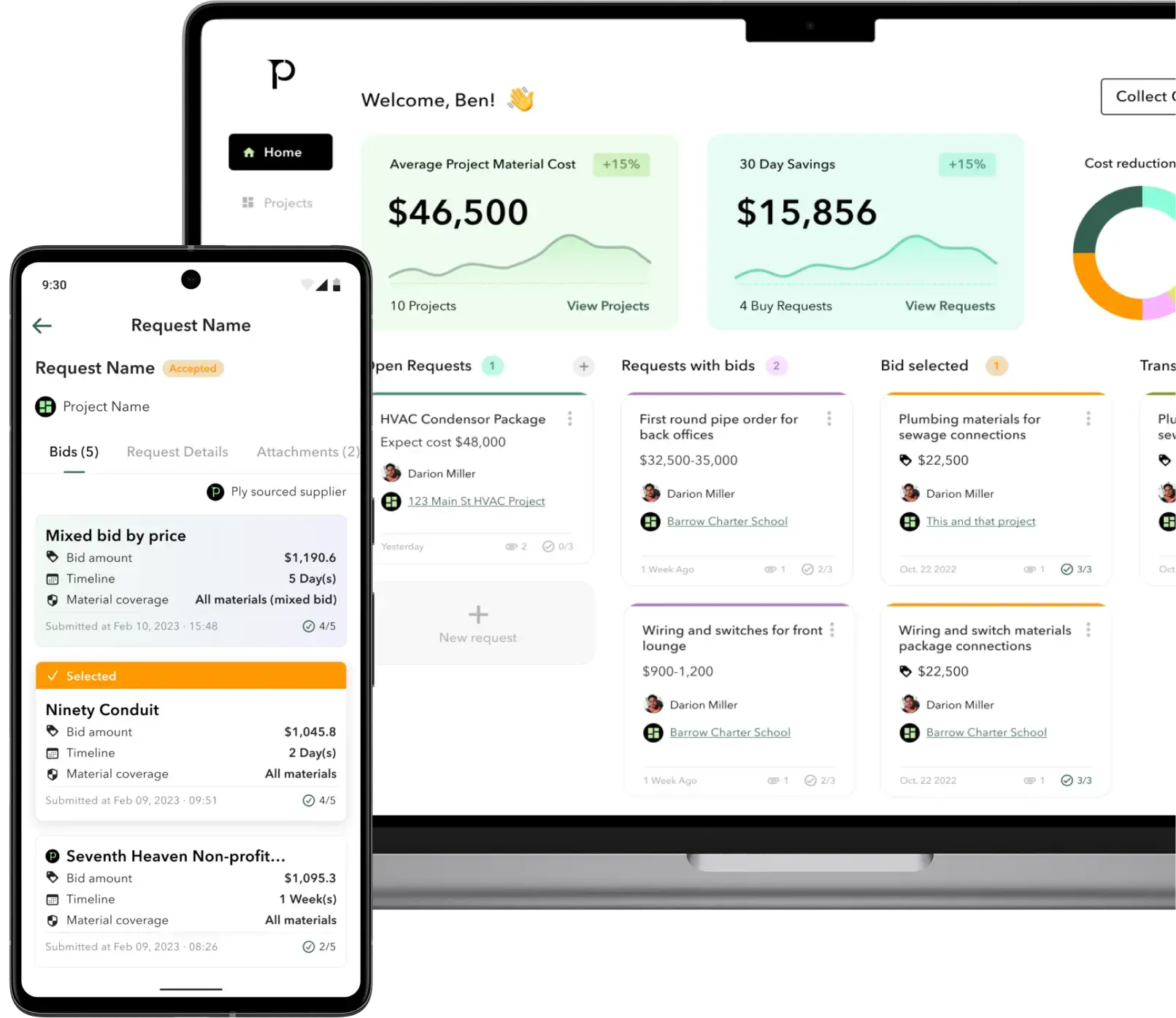
Ply: Connecting Material Requests, Suppliers, and Payments
Ply
A connected procurement platform for materials, payments and financing


Ply helps MEP contractors compare supplier quotes, purchase materials and manage payments in one place. We developed a connected web and mobile ecosystem with inventory tools, financial integrations and flexible payment options.
2-3x
Lower bills after architecture optimization
100+
Banks available to connect

Client Reviews of Dotcode Engineering and Integration Work





Who Leads IoT Engineering for Logistics Projects

Mariia Kunta
Chief Operating Officer
Mariia is the Chief Operating Officer at dotcode, where she oversees the operational department and shapes the company's organizational strategy. She leads a team of engineers through full-cycle development, from the first concept to post-launch monitoring, using Agile methods to keep delivery efficient, flexible, and high-quality. Her focus is on long-term partnerships with startups and established enterprises.
Technologies
Technology Stack for Logistics IoT Software
Connectivity
CellularLoRaWANWi-Fi
Messaging and Streaming
MQTTVendor APIsApache Kafka
Backend
JavaSpring BootNode.js
Cloud and Data
AWSGoogle CloudAzurePostgreSQLRedis
Dashboards and Apps
ReactTypeScriptKotlinWebSockets
Integrations
REST APIsTMSWMSERP
Why Dotcode
What Logistics Teams Get by Working With Dotcode
01
Code and Data Handover
Custom code lives in your GitHub repository from day one, under a signed NDA. Handover terms are fixed in the contract.
02
Progress You Can See
We track time and tasks openly, so you always know what is done and what comes next.
03
Engineers Close to Your Time Zone
With offices in Lviv, New York, London, Toronto, Melbourne and Dubai, we agree overlap hours with your team on the first call.
04
Integration Experience
We connect new software to existing systems as part of our software development services: on the Ply platform, we integrated Plaid, Railz, Lendflow and Stripe.
Logistics IoT Development FAQ
How much does logistics IoT development cost?
Projects start from $25,000. The final price depends on the number of devices and sites, device vendors, integrations and reporting needs. Our estimator gives a rough guide, and after discovery you get a detailed estimate.
How long does it take to build a logistics IoT solution?
A typical project takes 3 to 5 months from discovery to rollout. Timelines depend mostly on the number of integrations and device vendors. IoT logistics solutions development starts with a pilot on one route or site, so you see results before the full rollout.
Can you work with the trackers and telematics we already use?
Yes. We build an integration layer that keeps your current tracker vendors and adds one dashboard on top. We need API access or device documentation and a few test devices.
Can you integrate IoT data with our TMS, WMS or ERP?
Yes, through the APIs these systems provide. From your side, we need API access, documentation and a contact on your systems team. As a logistics IoT development company, we also handle data mapping, so events land in the right records.
Do you supply the tracking hardware?
We build the software layer and work with your device vendor or hardware team. If you are still choosing devices, we help compare options by data format, connectivity and API quality, so the hardware fits the software from the start.
How do you handle large volumes of device data and lost connections?
Where trackers support local storage, they can forward buffered readings after reconnecting. We use event timestamps and identifiers where available to handle late or repeated messages. During the pilot, we test how the dashboard and TMS show gaps, delayed readings and duplicate events.
Who owns the code and the data?
The custom code is yours: ownership, repository access and handover are agreed in the project contract. During discovery, we also check what each tracking provider lets you access, retain and export.
Let's talk
Tell us which trackers you use and which system needs their data, and include one shipment or warehouse workflow you want to improve. You get a reply within one business day.
Tell us about your project