





Smart home IoT
Home Automation IoT Development Services
Our home automation IoT development services cover apps, cloud platforms and device integrations for smart device makers and home service providers.
- Branded mobile apps
- Cloud platform
- Device integrations
- Controls during internet outages
5.0 on Clutch35 reviews
100%Upwork job success
Since 2017offices in New York and London
Why Home Automation Projects Fall Short After Launch
Device Brands Don't Work Together
Homeowners buy a lock from one brand, lights from another, a thermostat from a third. If your product works only with its own devices, users juggle three apps and blame the weakest one.
Commands Lag and Users Lose Trust
A light that turns on three seconds late feels broken. When commands take a slow cloud path or drop on a weak connection, users stop trusting the app and return to the wall switch.
Setup Is Too Hard for Non-Technical Owners
Pairing, Wi-Fi credentials and account linking confuse people who just want the device to work. When pairing fails, customers may abandon setup, contact support, or return a working device.
Home Data Raises Security and Privacy Questions
Cameras, locks and presence sensors know when people are home. Without clear protection of that data and of device access, buyers hesitate, and partners ask questions your team cannot answer yet.
Services
Home Automation IoT Development Services We Provide
Smart Home Architecture and Discovery
Our smart home systems development services start with discovery: we list the devices and brands your product must support, choose the target ecosystems and design the data model. We also decide what to build and what to take from existing platforms. You get an architecture document and a delivery plan.
Device Connectivity and Protocol Integration
We connect devices over Wi-Fi or cellular networks, use MQTT for device messages and integrate third-party devices through their APIs and SDKs. Each device reports its state in one common format, while the app shows each model's own features.
Cloud Platform and Automation Rules Engine
We build a cloud platform for connected devices with a device registry, current device state and automation rules, for example: if the door opens after 10 pm, send an alert. Java runs the business logic, and Node.js with WebSockets keeps the state live.
Mobile and Web Apps for Homeowners
Our smart home app development covers mobile apps for smart home control and a web dashboard. When a resident locks a door, the app shows the request as pending until the lock confirms it, and the last reported status if the lock goes offline.
Ecosystem Compatibility and Third-Party Integrations
Users expect their devices to work with the assistants and services they already use. During discovery, we assess compatibility with Alexa, Google Home and Apple Home for your device types and integrate third-party services through their official APIs.
Security, Testing and Post-Launch Support
We build in secure device onboarding, encrypted communication and access control, then test the whole chain with real devices. After launch, we monitor the platform, fix issues and add features as your user base grows.
One control flow, end to end: locking the front door
Pending until the lock confirms
Command from
Tap "Lock" in the app
Web dashboard
Automation rule
CloudSends the command
Wi-Fi or cellularMQTT
PendingDeviceThe lock confirms its stateConfirmed
The app shows
Status: Locked
Event logged
Last status if offline
Security and Access Control
In smart home security system development, the app shows which access code opened a lock, where the lock supports it, and lets owners grant temporary access to guests.
Lighting and Climate Control
Lights and thermostats follow schedules, presence and the owner's commands. Scenes such as "leaving home" switch off lights and lower heating in one tap.
Energy and Utility Monitoring
Smart meters and plugs report consumption. The app shows where energy goes, helps owners set schedules and compares use before and after a schedule change.
Safety Alerts and Preventive Maintenance
Leak, smoke and temperature sensors notify owners and, if set up, a service provider. If a sensor goes offline, the app shows when it last reported. Device health data flags low batteries early.
Who we work with
Who We Build Smart Home Software For
Smart Device Makers Adding an App and Cloud
Your hardware works, but the app and cloud are missing. We build both around your devices, as in our IoT product development services.
Startups Launching a Smart Home Platform
You have a product idea and no platform yet. We help you choose the scope for the first release and build it.
Property Developers and Home Builders
You want building-wide control for new homes. We build one platform for residents, managers and installers, where a former resident loses device access at move-out.
Energy and Security Service Providers
You monitor many homes and need one view. We build dashboards and alerts for your operators and an app for your customers.
How to choose
Build on a Smart Home Platform or Develop Custom Software: How to Choose
| Criteria | Existing smart home ecosystem (Google Home, Amazon Alexa) | Managed cloud IoT service (AWS IoT Core, Azure IoT Hub) | Custom cloud and apps |
|---|---|---|---|
| What you get | Control of compatible devices from the ecosystem's app |
Device connectivity and messaging at scale |
Your own platform, apps and automation logic |
| Your own brand and user experience | The ecosystem's app and rules |
A branded app can be built on top |
Your brand and your user flows |
| Compatibility with many device brands | Broad within the ecosystem |
Device integrations built on top |
Built for the brands your product needs, plus ecosystem integrations |
| Recurring fees as users grow | Depends on the ecosystem's terms |
Usage-based cloud fees |
Your own infrastructure costs |
| Control over data | Data follows the ecosystem's rules |
Data in your cloud account |
Full control over data and access |
| Best fit | Users who control a few off-the-shelf devices |
Teams with in-house engineers |
Device makers and service providers with their own product |
What to consider
The choice depends on whether you sell your own branded product and how much control you need over the user experience and data. Many products combine both: their own app and cloud, plus integrations with popular ecosystems so users keep their habits.
Home Assistant works differently: it runs on the user's own hardware, keeps data locally and can control compatible devices directly.
Custom home automation software development makes sense when
- You sell a branded product.
- You need your own automation logic.
- You want to keep user data and recurring revenue under your control.
Process
How a Home Automation IoT Project Runs, Step by Step
-
Discovery and device audit
We list devices, brands, protocols and target ecosystems.You get: Device and ecosystem map Owner: Solution architect, tech lead Duration: 2-3 weeks
-
Architecture and ecosystem choice
We design the cloud, data model and integration plan.You get: Architecture and integration plan Owner: Tech lead Duration: 1-2 weeks
-
Proof of concept with real devices
Smart home automation development starts with real devices: one end-to-end control flow on the agreed pilot hardware.You get: Working demo, for example a lock command that stays pending until the lock confirms it, and a list of risks Owner: Backend engineer Duration: 3-5 weeks
-
MVP app and cloud
We build the mobile app, web dashboard and rules engine for the pilot, following our MVP development approach.You get: MVP ready for pilot homes Owner: Project manager and team Duration: 10-14 weeks
-
Pilot homes, release and support
Test pairing on a replacement router, check which controls still work during an internet outage, and verify that a former resident loses access after move-out. Then release with monitoring.You get: Pilot results against these checks, release and a support plan Owner: QA engineer, project manager Duration: 4-8 weeks, then ongoing
Cost and timeline
Home Automation IoT Development Cost and Timeline
Six factors shape the budget:
- 1The number and brands of devices
- 2Protocols and ecosystems
- 3Ecosystem and third-party integrations
- 4App platforms (iOS, Android, web)
- 5Security and privacy requirements
- 6Analytics and reporting
After launch, plan for cloud hosting and support, which grow with the number of active homes. We estimate them together with the build, so you see the full cost of running the product. For a first figure, get an IoT project estimate in our estimator as a rough guide.
Proof of concept
One end-to-end control flow on the agreed pilot hardware
Typical timeline: 4-6 weeks
MVP
Mobile app, cloud, rules engine
Typical timeline: 3-4 months
Full platform
Several device brands, ecosystem integrations, web dashboard
Typical timeline: 6-9 months
Smart home projects start from$25,000
Get an IoT estimate
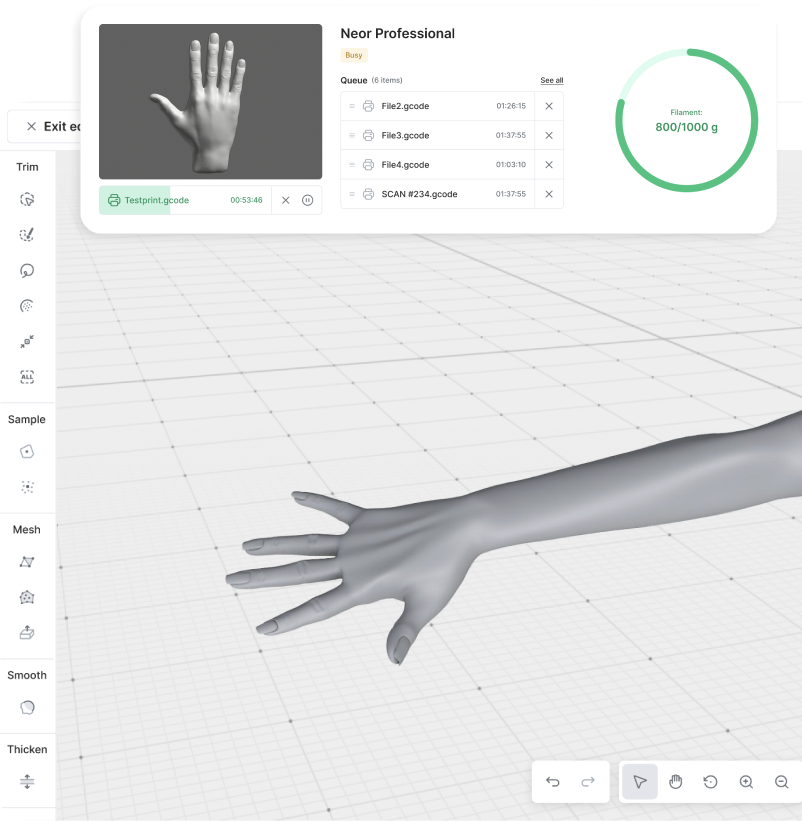
Related Work: Desktop Software for a 3D-Printing Workflow
XO Armor
One desktop workflow for customized 3D-printed protective devices


XO Armor helps healthcare professionals turn body scans into personalized protective devices. We brought scan processing, 3D model editing and printer integration into a single desktop application, simplifying a process that previously required three apps.
≤1 hour
From body scan to a printed protective device
3 to 1
Applications consolidated into one workflow
What Clients Say About Working With Dotcode





Who Leads Smart Home IoT Engineering at Dotcode

Mariia Kunta
Chief Operating Officer
Mariia is the Chief Operating Officer at dotcode, where she oversees the operational department and shapes the company's organizational strategy. She leads a team of engineers through full-cycle development, from the first concept to post-launch monitoring, using Agile methods to keep delivery efficient, flexible, and high-quality. Her focus is on long-term partnerships with startups and established enterprises.
Technologies
Technology Stack for Smart Home Software
Connectivity
Wi-FiCellular
Messaging and Real-Time
MQTTWebSockets
Backend
JavaNode.js
Cloud and Data
AWSGoogle CloudAzurePostgreSQLMongoDB
Mobile and Web
FlutterReact NativeSwiftKotlin
Third-Party APIs
Ecosystem APIsPartner APIs
Why Dotcode
What You Get by Building Your Smart Home Product With Dotcode
01
You Own the Code and the Data
Code sits in your repository from day one, the contract sets your rights to it, and access to residents' data follows your policies.
02
Progress You Can See
We track time and tasks openly, so you always know what is done and what comes next.
03
Mobile, Cloud and Web From One Team
One team builds the app, the cloud and the web dashboard as part of our software development services, so home automation app development and the backend move at the same pace.
04
Engineers Close to Your Time Zone
We agree overlap hours with your team, so calls, reviews and urgent fixes fit your working day.
Home Automation IoT Development FAQ
How much does smart home IoT development cost?
Projects start from $25,000. The final cost depends on the number of device brands, ecosystems and integrations, app platforms and security requirements. Our estimator gives a rough guide, and after discovery you get a detailed estimate.
How long does it take to build a smart home app and cloud platform?
A typical project takes 4 to 7 months from discovery to the first release. The main factors are the number of device brands and integrations. A proof of concept with real devices comes first, so you see the product working early.
Can you integrate with Alexa, Google Home or Apple Home?
Support depends on the ecosystem, the device type and how the device is controlled. During discovery, we check the requirements of the ecosystems your buyers use and agree which integrations to validate first.
Which protocols and device brands do you support?
Devices connect over Wi-Fi or cellular networks and exchange messages with the cloud over MQTT. Third-party brands are integrated through their APIs and SDKs. We confirm the exact list of devices and brands for your product during discovery.
Do you develop the smart devices themselves?
No. Your hardware team or manufacturer supplies the devices. Our IoT solution development for smart home products covers the apps, cloud services and integrations around them.
How do you protect home data and device access?
We use encrypted communication, secure device onboarding and role-based access, so only authorised users control a device. Security is tested with real devices before release. For UK launches, discovery covers whether PSTI applies: password rules, a vulnerability reporting channel, the published security update period and the statement of compliance. For US products, we use NIST IR 8425 as a reference for consumer IoT security.
Who owns the code and the data?
The code sits in your repository from day one, and the contract sets your rights to it and lists third-party licences. Where residents' data is stored and who can access it is fixed in the contract and your privacy policy.
Let's talk
Tell us about your product and the devices it must support. You get a reply within one business day, then a call on smart home IoT development for your product, starting with which integrations to validate first.
Tell us about your project