






Hardware development
IoT Hardware Development Services
Our IoT hardware development services cover the electronics and firmware of your connected device, prototype testing and the files your manufacturer needs for a pilot run.
- Electronics and PCB
- Firmware
- Prototype testing
- Connected to your cloud and apps
5.0 on Clutch35 reviews
100%Upwork job success
Since 2017offices in New York and London
Where IoT Hardware Projects Go Wrong Before the First Batch
Bench Tests Miss Field Failures
In IoT hardware development, many problems appear only after the bench test. Inside a metal cabinet or outdoors, the device loses connection or resets. The fix can require a board revision or changes to the enclosure or firmware.
Battery Life Misses the Target
The product promises a year on one battery, and the prototype lasts weeks. The power budget was never checked against sensor polling, radio use and sleep modes, so the fix touches hardware and firmware.
Components Run Out or Change Mid-Project
A chip chosen for the prototype goes out of stock or reaches end of life. Without alternatives planned in advance, the team redesigns the board while the launch date moves.
Firmware and Cloud Interfaces Diverge
The board is ready, but the data format, update path and security were never agreed with the cloud team. Integration turns into rework on both sides.
Services
IoT Hardware Development Services We Provide
Hardware Architecture and Component Selection
As an IoT hardware development company, we turn product requirements into a device architecture: sensors, microcontroller or radio module, power budget and enclosure limits. Component choices include alternatives for supply risks. You get an architecture document and a component list.
Electronics and PCB Design
We design schematics and board layouts and review them against size, power and manufacturing requirements. Each revision is checked before boards are ordered. You get complete design files ready for prototype production.
Firmware and Embedded Software
We write device firmware for sensor reading, power management and secure over-the-air updates. We agree the data format with your cloud team, choose the messaging protocol, such as MQTT, and connect over Wi-Fi, cellular or LoRaWAN.
Connectivity Integration
We choose and integrate the radio that fits your range, power and data volume, and connect the device to a cloud backend for device data. Connectivity is tested in the conditions where the device will actually work.
Prototyping and Hardware Testing
We build working prototypes and test them on the bench and in the field. We check what happens when the device loses power or connection while sending data, and how it recovers its readings and settings.
Pilot Batch and Manufacturing Handover
We prepare documentation, the bill of materials and test procedures, and coordinate with your contract manufacturer on the pilot batch. Production stays with the manufacturer, while we stay responsible for the design.
What goes into one connected device
Designed and tested as one product
Sense
Sensors
Battery
Power design
ProcessElectronics and firmware
MCU and PCBFirmwareSecure updates
ConnectRadio and protocol
Wi-FiCellularLoRaWANMQTT
Use and make
Cloud backend and apps
Production files
Your manufacturer
Battery-Powered Sensors and Trackers
Small devices that must meet a defined battery-life target. They wake up, measure, send a short message and sleep. The cloud side handles irregular check-ins and long gaps.
Connected Consumer Devices and Wearables
Devices people carry or use at home, paired with a mobile app. They need a simple setup, reliable pairing and a clear way to show data to non-technical users.
Industrial and Asset Monitoring Devices
Sensors on machines, tanks or equipment that report condition and usage. They need rugged enclosures, stable connectivity in difficult places and data that fits maintenance workflows.
Gateways and Edge Devices
Devices that collect data from local sensors and pass it to the cloud. They buffer readings when the connection drops and send them when it returns.
Who we work with
Who We Develop IoT Hardware For
Hardware Startups With a Concept
You have a product idea and no engineering team. We take it from requirements to working IoT hardware solutions and keep the cloud and the app in the same plan.
Manufacturers Adding Connectivity to Existing Products
Your product sells well, and the market now expects it to be connected. We design the electronics and firmware that add data and remote control to your product.
Medical and Wellness Device Makers
Your device must exchange data reliably with a patient or clinician app. We define the device-to-app interfaces and who verifies each one, as in our XO Armor scanner software.
Teams That Already Have a Hardware Vendor
Your device is designed elsewhere. We connect its firmware to the cloud and apps, test the integration on your sample units and log every interface issue for your vendor.
How to choose
Dev Kit, Module or Custom Board: How to Choose
| Criteria | Dev kit in an enclosure | Certified module on a custom carrier board | Board with a discrete radio design |
|---|---|---|---|
| What it is | Ready development board with sensors in a case |
Your own board built around a pre-certified radio module |
Your own board with the radio circuit designed in |
| Unit cost | Higher per unit; fits small quantities |
Module price is part of every unit; less engineering |
Can be lower at higher volumes, after extra engineering and testing |
| Certification effort | Depends on the kit; the final product still needs testing |
Reduced for the radio part thanks to the certified module |
The radio design is tested as part of the finished device |
| Size and power | Limited by the kit |
Optimised around the module |
Can be optimised for size and power |
| Flexibility later | Limited |
Board can change, module stays |
Full control over future revisions |
| Best fit | Early tests and small pilots |
Most connected products at moderate volumes |
High volumes and strict size or battery limits |
What to consider
The right hardware path depends on your volumes, size limits and how soon you need the first units.
Many products move through all three stages, and a module may remain the better choice across several production runs. We help you pick the point where each step pays off, so the IoT hardware solutions you choose match the business plan, not just the prototype.
Before a custom radio design
- It can reduce unit cost or board size at higher volumes.
- We compare those savings with the extra engineering, testing and manufacturing costs.
- The comparison uses your expected order quantities.
Process
How an IoT Hardware Project Runs From Concept to Pilot Batch
-
Requirements and feasibility
We define what the device must do, where it will work and what it may cost.You get: Requirements and a risk list Owner: Solution architect, hardware lead Duration: 1-2 weeks
-
Architecture and component selection
We choose the sensors, processor, radio and power design.You get: Architecture and a draft bill of materials Owner: Hardware lead Duration: 2-3 weeks
-
Prototype and firmware bring-up
We build the first boards and bring up the firmware, following our MVP development logic: reduce the biggest risk first.You get: Working prototype sending data to a test cloud Owner: Hardware and firmware engineers Duration: 8-12 weeks
-
Testing and design revision
Bench and field tests against agreed criteria: power use in agreed modes, connection inside the target enclosure, recovery after power loss.You get: Test report, revised design and your go-ahead for the pilot batch Owner: QA engineer, hardware lead Duration: 4-8 weeks
-
Pilot batch and manufacturing handover
We prepare production files and support the pilot run.You get: Production files and documentation Owner: Hardware lead, project manager Duration: 4-6 weeks
Cost and timeline
IoT Hardware Development Cost and Timeline
The budget depends on six factors:
- 1Device complexity
- 2Connectivity
- 3Battery and size limits
- 4Firmware scope
- 5Certification scope
- 6The cloud and app scope
Hardware costs have a clear structure. One-time engineering covers design, prototypes and testing. Per-unit cost covers components and assembly and falls with volume. After launch, cloud hosting, connectivity and support continue. The estimate lists its assumptions and shows whether tooling, test fixtures, lab testing and an extra board revision are included. For a first figure, get an IoT project estimate in our estimator as a rough guide.
Proof of concept on a dev kit
Ready board, firmware, data to a test cloud
Typical timeline: 4-6 weeks
Working prototype
Custom electronics, firmware, cloud connection
Typical timeline: 3-5 months
Pilot batch
Revised design, production files, manufacturing handover
Typical timeline: 6-9 months
IoT hardware projects start from$25,000
Get an IoT estimate
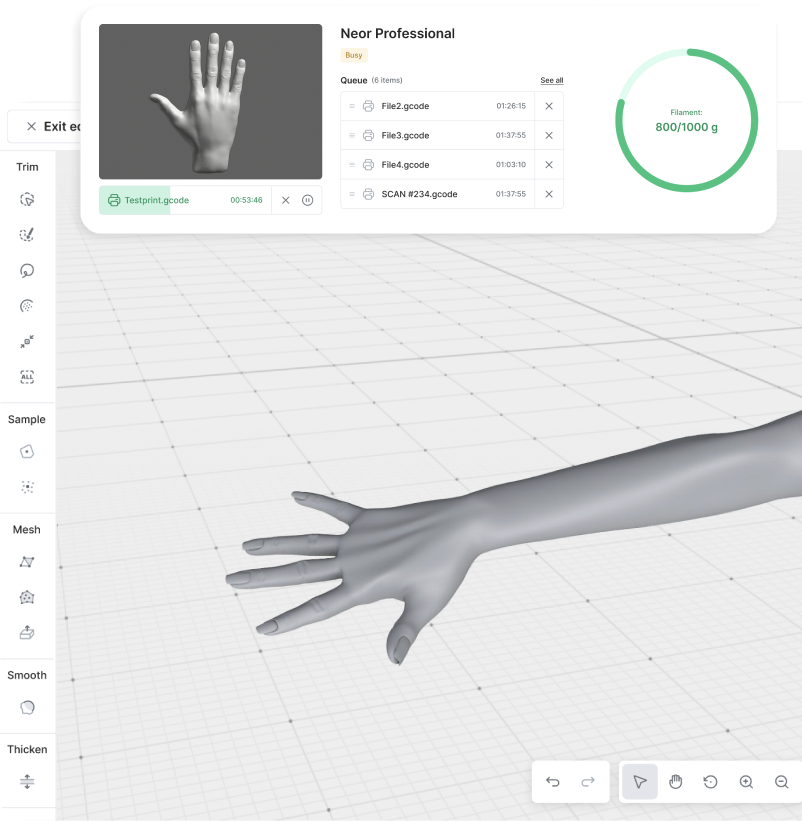
A Related Project: Software for a Scanner-to-Printer Workflow
XO Armor
One desktop workflow for customized 3D-printed protective devices


XO Armor helps healthcare professionals turn body scans into personalized protective devices. We brought scan processing, 3D model editing and printer integration into a single desktop application, simplifying a process that previously required three apps.
≤1 hour
From body scan to a printed protective device
3 to 1
Applications consolidated into one workflow
What Product Teams Say About Working With Dotcode





Who Leads IoT Hardware Engineering at Dotcode

Mariia Kunta
Chief Operating Officer
Mariia is the Chief Operating Officer at dotcode, where she oversees the operational department and shapes the company's organizational strategy. She leads a team of engineers through full-cycle development, from the first concept to post-launch monitoring, using Agile methods to keep delivery efficient, flexible, and high-quality. Her focus is on long-term partnerships with startups and established enterprises.
Technologies
Technology Stack for IoT Hardware Projects
Microcontrollers and Processors
STM32ESP32Nordic nRF52
Firmware and Operating Systems
CC++FreeRTOSZephyrEmbedded Linux
Wireless Connectivity
Wi-FiCellularLoRaWAN
Messaging and Updates
MQTTSecure OTA updates
Cloud Backend
JavaNode.jsWebSocketsAWSGoogle CloudAzure
Testing Tools
OscilloscopeLogic analyzerPower profilerUnity
Why Dotcode
What You Get by Developing IoT Hardware With Dotcode
01
Design Files and Manufacturing Handover
From an IoT hardware development company, you should get more than a prototype: editable schematics, PCB layouts, firmware source and manufacturing files, so another engineer can change the design and order the next batch.
02
Progress You Can See
We track time and tasks openly, so you always know which revision is in progress and what comes next.
03
One Team for Device, Cloud and App
The same team designs the device, the cloud and the app, backed by our software development services. Interfaces are agreed early, and integration does not turn into rework.
04
Engineers Close to Your Time Zone
With offices in Lviv, New York, London, Toronto, Melbourne and Dubai, meetings and reviews fit your working day.
IoT Hardware Development FAQ
How much does IoT hardware development cost?
Projects start from $25,000. The final cost depends on device complexity, connectivity, battery and size limits, firmware and certification scope. Our estimator gives a rough guide, and after the requirements stage you get a detailed estimate.
How long does it take to develop an IoT device?
A typical project takes 6 to 9 months from concept to pilot batch. The main factors are whether you need a custom board or a module-based design, and how much certification the device requires.
Which parts of an IoT device do you develop?
We cover architecture, electronics, firmware, cloud and apps. Our IoT hardware development solutions are scoped per project, so you can order the full device or only the parts your team does not cover.
Can you work with our existing hardware or contract manufacturer?
Yes. We integrate firmware, cloud and apps with your current hardware and work directly with your manufacturer. We need the specification, the SDK and a few test units. Working with an IoT hardware development company that also builds the software keeps one owner for the whole chain.
Who handles testing and market approvals?
During discovery, we identify the target markets and agree who will prepare the design files, arrange testing, and maintain the conformity documentation. The route depends on the finished device, its radio configuration, and where it will be sold. If the design uses a pre-certified module, we check its integration conditions and the requirements that still apply to the finished product.
How do you secure an IoT device?
Security is part of the design, not an add-on. We plan encrypted communication, device identity and a secure update path from the start and test them together with the cloud side.
What files do we receive at handover?
We agree on the handover package and ownership terms before development starts. Depending on scope, the package includes editable schematics and PCB layouts, firmware source, a bill of materials, manufacturing files, and test procedures. We identify third-party components and their licences separately.
Let's talk
Tell us what your device needs to do, where it will operate, and what you want to prove with the first prototype. You get a reply within one business day, then a free consultation on the IoT hardware solutions that fit your product and budget.
Tell us about your project