




IoT product development
IoT Product Development Services
Our IoT product development services take your working prototype to the first customer devices, with the backend, alerts and apps built around your hardware.
- Fleet backend
- Offline alerts
- Mobile and web apps
- Tested on your devices
5.0 on Clutch35 reviews
100%Upwork job success
Since 2017offices in New York and London
Why IoT Products Stall Between Prototype and Production
The Prototype Works, but the Fleet Has No Backend
Teams often come to an IoT product development company with a prototype that streams data to a laptop. Nobody has built the layer that registers devices, handles dropped connections and shows support what each unit is doing, so the pilot cannot grow beyond a few units.
Data Arrives, but Nobody Acts on It
Readings pile up in a database, but no rule turns them into an alert, a report or an action. Operators still check charts by hand, and the value the product promised to its buyers never appears.
Platform Fees Eat Into Product Margins
A ready-made platform is a fast start, but its pricing often grows with every connected unit. At fleet scale, subscription costs eat into the margin, and moving data and logic to your own backend gets harder each month.
Connectivity Fails in the Field, Not in the Lab
Office Wi-Fi hides real problems. In a field, a warehouse or a basement, devices lose signal, send duplicates and reconnect all at once. Software that was never tested against weak connectivity loses data exactly where customers depend on it.
Services
IoT Product Development Services We Provide
IoT Architecture and Discovery
Custom IoT development services start here: we list your devices, map their data and choose the connectivity and data model. We also answer the build-or-buy question: which parts can run on a ready platform and which need custom code. You get an architecture document and a delivery plan.
Device Connectivity and Data Ingestion
Devices connect over LoRaWAN, Wi-Fi or cellular networks, and MQTT carries their messages to the cloud. Our ingestion layer validates each message and stores it for your app and analysts. Java typically handles storage and business logic, and Node.js the real-time stream.
Cloud Platform and Device Management Dashboards
We set up cloud and DevOps on AWS for device data and build dashboards where your team registers devices, checks their status and sees every reading in one place. The setup is sized for your pilot and ready to grow with the fleet.
Mobile and Web Apps for Connected Products
We deliver mobile app development for connected products on iOS and Android, plus web portals for customers and operators. When the signal is weak, the app shows the last known reading with its time and marks commands that are still pending.
Analytics and AI on Device Data
Raw readings become reports, trends and anomaly alerts. Our data engineering and analytics team builds the data pipelines and dashboards. For AI features, such as an assistant that answers questions about device data, our LLM development services team joins the project.
End-to-End Testing and Post-Launch Support
We test the whole chain: device, connectivity, cloud and app. A typical check: we cut a test device's connection, restore it and confirm that no readings are lost or duplicated. After launch, we monitor the system and add features as the fleet grows.
How a connected product fits together
Device to people, one data path
Your devices
Sensors
Firmware
Prototype or series
ConnectivityNetwork and messaging
LoRaWANWi-FiCellularMQTT
CloudBackend on AWS
IngestionRules and alertsStorage
People and systems
Mobile and web apps
Fleet dashboard
ERP, CRM, billing
Real-Time Monitoring and Alerts
With our custom IoT development services, the backend checks each reading against the limits you set. When a value goes out of range or a device goes silent, the right person gets an alert in the app or by email, with the device and reading attached.
Rule-Based Automation and Remote Control
A rule fires when a reading crosses a threshold. For example, when soil moisture drops below the set level, the system starts irrigation. Users can also send commands to devices from the app, and every event is logged for later analysis.
Device Fleet Management
One dashboard shows every device, its status, last connection and data history. Support sees when each unit last checked in and can tell whether an outage affects one device or a whole site, then group devices by customer or location.
Integration With Your Existing Business Systems
Device data does not stay in a separate silo. We connect the IoT platform to your ERP, CRM or billing system through the APIs and access rights they provide, so orders, service tickets and invoices reflect what the devices actually report.
Who we work with
Who We Build Connected Products For
Hardware Startups
You have a device on a dev board and need the cloud, the app and the fleet dashboard before pilot units ship. Our custom IoT development services build the software layer around your prototype and prepare it for the first customers.
Equipment Manufacturers
Your product already sells, and now it needs to report data and accept commands. We connect it to a cloud backend and link the data with your ERP and service processes.
Medical Device Companies
We map how device readings reach clinicians or patients, who can access them, and what the app shows when data is delayed or missing. Together with your team, we agree on software responsibilities and validation evidence during discovery. More on our healthcare software development.
Agriculture and Infrastructure Operators
Your sensors work in fields, along pipelines or at remote sites with weak connectivity. We build backends that handle long gaps in the signal and turn readings into actions, as described in our article on IoT in smart agriculture.
How to choose
Managed IoT Cloud, IoT Platform or Custom Backend: How to Choose
| Criteria | Managed IoT cloud (AWS IoT Core, Azure IoT Hub) | Ready-made IoT platform (ThingsBoard, Particle) | Custom backend |
|---|---|---|---|
| What you get | Device connectivity, messaging and security at cloud scale |
Dashboards, device management and rules out of the box |
Backend, dashboards and apps built around your product logic |
| Control over data | Data in your cloud account, logic built by your team |
Data and logic follow the platform's model |
Full control over the data model, storage and logic |
| Cost as the fleet grows | Usage-based cloud fees |
Licence, subscription or device-based tiers, depending on the vendor |
Development, maintenance, monitoring and infrastructure costs, no platform licence per device |
| Integration flexibility | Broad, through cloud services and your own code |
Limited to the platform's connectors and APIs |
ERP, CRM or billing systems, depending on available APIs and access rights |
| Brand and user experience | Built by your team |
Platform look with customisation limits |
Your brand and your user flows |
| Best fit | Teams with their own engineers who want managed connectivity |
Products with standard dashboards and device management |
Products with their own logic, integrations and a growing fleet |
What to consider
There is no single right answer: the choice depends on the size of your fleet, your integrations and how much control you need over data.
Many products combine the options: a managed cloud for connectivity and custom code for the business layer. Our custom IoT development services cover that business layer.
A custom backend makes sense when
- The product has its own logic.
- It needs deep integration with business systems.
- Per-device fees start to outweigh the cost of building and running your own backend.
Process
How an IoT Project Runs From First Prototype to Pilot Fleet
-
Discovery and architecture
We review the device, the data it sends and your business goals, then choose connectivity and the platform approach.You get: Architecture document, delivery plan and estimate Owner: Solution architect, tech lead Duration: 2-3 weeks
-
Proof of concept
One real device sends data through the cloud to a basic dashboard.You get: Working demo and a list of technical risks Owner: Backend engineer Duration: 3-4 weeks
-
MVP
We build the backend, the app and the device dashboard the pilot needs, following our MVP development approach.You get: MVP ready for pilot users Owner: Project manager and team Duration: 8-12 weeks
-
Pilot in the field
We disconnect and reconnect pilot devices, check for missing or duplicate readings and verify what users and support staff see.You get: Pilot results against agreed acceptance criteria, with fixes prioritised before rollout Owner: QA engineer, project manager Duration: 4-8 weeks
-
Release, scale and support
We release to production, set up monitoring and plan the next features.You get: Live system, monitoring and a support plan Owner: Tech lead, support team Duration: 2-4 weeks, then ongoing
Cost and timeline
IoT Product Development Cost and Timeline
The budget depends less on the number of screens and more on the device side of the product. Six factors shape it:
- 1The number and types of devices
- 2The connectivity method
- 3Hardware readiness (concept, prototype or series)
- 4The number of integrations
- 5Security and compliance requirements
- 6The scope of analytics, AI and support
After launch, plan for running costs: cloud hosting, connectivity per device and support. They grow with the fleet, so we estimate them together with the build. For a first figure, get an IoT project estimate in our estimator. It gives a rough guide, and the detailed quote follows discovery.
Proof of concept
One device type, data path to the cloud, basic dashboard
Typical timeline: 4-6 weeks
MVP
Backend, mobile or web app, device dashboard
Typical timeline: 3-4 months
Production platform
Fleet management, integrations, analytics, support
Typical timeline: 6-9 months
IoT projects start from$25,000
Get an IoT estimate
XO Armor: Three Apps Combined Into One Scan-to-Print Workflow
XO Armor
One desktop workflow for customized 3D-printed protective devices


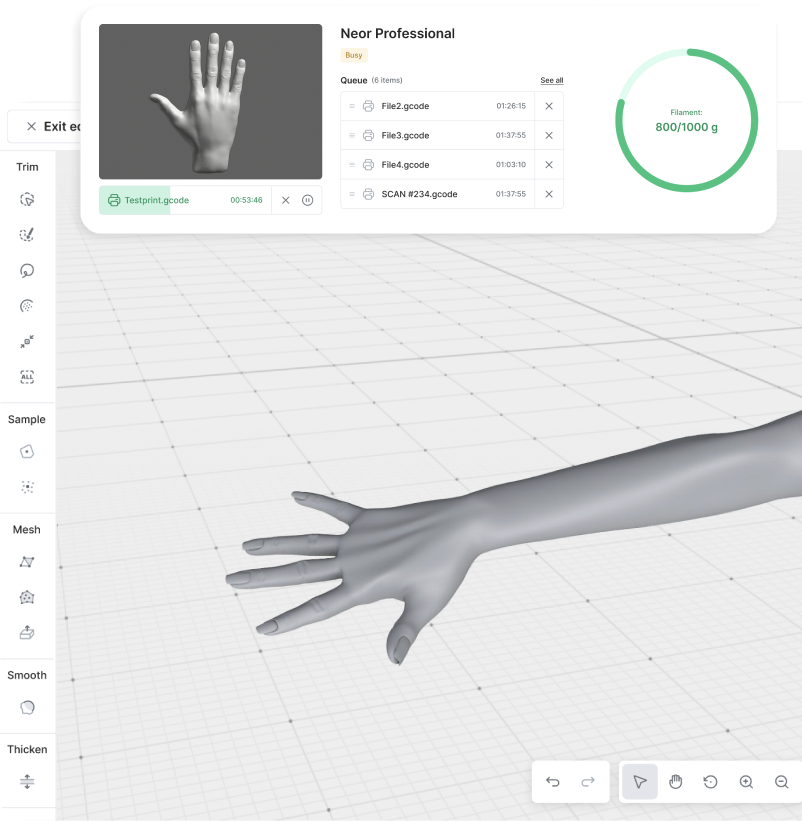
XO Armor helps healthcare professionals turn body scans into personalized protective devices. We brought scan processing, 3D model editing and printer integration into a single desktop application, simplifying a process that previously required three apps.
≤1 hour
From body scan to a printed protective device
3 to 1
Applications consolidated into one workflow
Client Feedback on Dotcode Delivery





Who Leads IoT Engineering at Dotcode

Mariia Kunta
Chief Operating Officer
Mariia is the Chief Operating Officer at dotcode, where she oversees the operational department and shapes the company's organizational strategy. She leads a team of engineers through full-cycle development, from the first concept to post-launch monitoring, using Agile methods to keep delivery efficient, flexible, and high-quality. Her focus is on long-term partnerships with startups and established enterprises.
Technologies
Technology Stack for Connected Products
Backend
JavaNode.js
Real-Time and Messaging
WebSocketsMQTT
Cloud and DevOps
AWSGoogle CloudAzureDockerKubernetes
Databases
PostgreSQLMongoDB
Mobile and Web
FlutterReact NativeSwiftKotlin
Connectivity
LoRaWANWi-FiCellular
Why Dotcode
What Companies Get by Working With Dotcode on IoT
01
Code and Data Ownership
With Dotcode as your IoT product development company, the custom code we write is yours and lives in your GitHub repository from day one, under a signed NDA.
02
Post-Payment Model
We work on a post-payment basis, so you are not taking a leap of faith with a new technology partner.
03
AWS Partner Network
Dotcode is part of the AWS Partner Network, the AWS programme for companies that build and deliver solutions on AWS.
04
Transparent Tracking
We track time and tasks openly, as in all our software development services, so you always see where the project stands, what is done and what comes next.
IoT Product Development FAQ
How much does it cost to develop an IoT product?
Projects start from $25,000, and the final cost depends on your device and scope. The main factors are the number and types of devices, connectivity, hardware readiness, integrations, security requirements and analytics. Our estimator gives a rough guide, and after discovery you get a detailed estimate.
How long does it take to develop an IoT product?
A typical project takes 4 to 6 months from discovery to pilot. Hardware readiness changes the timeline most: a stable prototype speeds the work up, while a device that is still changing adds rounds of rework. Each integration with business systems also adds time.
Do you build the device hardware too?
We build the software layer of connected products: connectivity, cloud, apps and analytics. We work with your hardware team or manufacturer on the device interface, data format and firmware integration points, so the device and the software fit from the start.
Can you work with our existing prototype or device?
Yes. We start from the device you already have and build the backend and apps around it. To begin, we need the device specification or SDK, a description of the data it sends and a few test units for the proof of concept.
Which protocols and cloud platforms do you work with?
We work with MQTT, LoRaWAN, Wi-Fi and cellular connectivity and deploy on AWS, Google Cloud or Azure. The backend runs on Java and Node.js, with WebSockets for live updates in apps. We choose the combination during discovery based on range, power and data volume.
Who owns the code and the data?
The custom code we write belongs to you and is stored in your GitHub repository from day one, under a signed NDA. Open-source and third-party components keep their own licences. Where device data is hosted and how you export it are fixed in the contract before development, so you can continue with any team.
Should we use a ready-made IoT platform or build custom?
A ready-made platform is a quick start for standard dashboards and device management. Custom IoT development solutions pay off when the product has its own logic, deep integrations or a fleet where per-device fees outweigh building and running your own backend.
Let's talk
Share a short, high-level description of your device and goals. You get a reply within one business day, and we sign an NDA before discussing technical details.
Tell us about your project