


Order Management
Software Development Services

Build a scalable system to automate your sales and logistics

When order volume grows, the cracks show fast. Missed orders, manual reconciliation, fulfillment delays that nobody catches until a client calls. The problem is not the team, it is the absence of a proper order management software built for how your operation actually works. Dotcode builds custom order management software from the data model up: your channels, your rules, your integrations.


Why Businesses Need Custom OMS

Orders getting lost between channels

When email, marketplace, phone, and EDI all land in different places, someone eventually misses one. There’s no malice involved – it’s just what happens when there’s no single view of what’s come in. The customer finds out when nothing arrives, and by then the damage is done.

Manual processing quietly kills margins

Copy-paste between spreadsheets, ERP, and courier portals looks manageable when volume is low. At scale it’s a full-time job that produces errors. In F&B operations running thin margins, that overhead compounds faster than most teams realise until they sit down and actually measure it.

Off-the-shelf tools stop fitting at some point

Generic OMS products are designed for the median use case. They work fine until your workflow, your integrations, or your pricing structure stops being median. Then you’re either bending your operations to match the software’s logic, or you’re living with workarounds that create their own overhead.

Fulfillment chain visibility - or the lack of it

‘Where is my order?’ is the support question every ops team dreads, because the honest answer is often ‘I have to check a few places’. Customers notice. B2B clients especially – reliability is the primary reason they stay, and the primary reason they leave.

Not sure which service fits your case?

Book a discovery call

Order management solutions we build

The right order management solution depends on your business model, how many channels you’re running, and how complex your fulfillment rules are. Six types we build most often:

01
Centralised Multi-Channel OMS

One dashboard for every order from every channel – website, marketplaces, B2B portal, POS. Single source of truth for inventory. One interface for the fulfillment team instead of five tabs open at once. The coordination overhead this removes is usually larger than teams expect before they measure it.

Unified ecosystem
02
B2B Order Management Software

Client portals with contract pricing, approval chains, credit management, and EDI. Built for distributors and manufacturers whose customers are businesses with complex commercial terms – tiered pricing, account-level credit limits, order history going back years. Not the kind of thing a standard ecommerce checkout was ever designed to accommodate.

Automated B2B flows
03
Ecommerce Order Management Software

Automated routing, split shipments, returns and exchanges without manual involvement. The system connects your D2C channels to warehouse and carrier – so the gap between ‘order placed’ and ‘dispatched’ closes on its own, not because someone is watching a queue.

Zero-touch fulfillment
04
Order Management Software for Small Business

Order management software for small business that doesn’t come with six months of implementation. Fast setup, straightforward interface, pre-built integrations for Shopify and WooCommerce. The idea is that a small team gets enterprise-level operational visibility without an enterprise-level project to get there.

Rapid deployment
05
Order Tracking Software

Branded tracking pages, carrier sync that actually runs in real time, automated notifications at each milestone. Order tracking software doesn’t just reduce inbound support volume – it changes how customers experience the post-purchase period, which matters more than most businesses measure.

Customer transparency
06
OMS for Distributors

Multi-route order management with route-to-market logic, batch processing, and credit management for F&B distributors. Handles hundreds of delivery points, varied pricing tiers, compliance documentation requirements – the edge cases that standard OMS tools treat as too niche to bother with.

Regional supply control
Order Management Software Development Services

What we build

We cover the full range of order management software development work – from building systems from scratch to integrating existing ones into a wider stack. Seven service lines, briefly:

Custom Order Management Software

A custom order management software build scoped entirely around your operation. Sales channels, warehouse rules, fulfillment logic, pricing structure – all designed to match what actually happens in your business, not what a product manager assumed would be common. We start from the data model, not from a template.

Order Management System Development

End-to-end order management system development covering architecture, data modelling, API layer, operational UI, and customer-facing portal. The scope depends on your order volume, your channel count, and how much latency your operation can tolerate between order receipt and fulfillment trigger.

OMS Integration & Middleware

Connecting an OMS to ERP, WMS, CRM, marketplaces, and carriers is often where the real complexity sits. We build the middleware layer that keeps order state consistent across systems – so nothing has to be manually reconciled between platforms at end of day.

B2B Order Management Software

Wholesale and distributor operations have commercial complexity that consumer-facing tools never handle well. B2B order management software built here covers client portals with contract pricing, credit limits, minimum order enforcement, approval workflows, and EDI integrations – the kind of logic that lives in spreadsheets and email threads until someone builds it properly.

Ecommerce Order Management Software

Ecommerce order management software that pulls orders from every D2C channel into one place: website, marketplaces, social commerce. Automated routing, split shipments, returns handling – without someone manually touching each order at every step.

Order Tracking Software

Order tracking software with live status visible to the end customer: branded tracking pages, automated email and SMS at each status change, carrier integrations that actually stay in sync. Reduces ‘where is my order?’ support volume without requiring any staff involvement per shipment.

OMS Audit & Modernization

If you already have a system that’s become a bottleneck, we audit it – identify where the failures are, what’s salvageable, what needs replacing. Sometimes the answer is targeted refactoring. Sometimes it’s migration to a new architecture. Either way, the existing system gets evaluated against what the business actually needs today, not what it needed when it was built.

Who We Work With

Businesses we build order management software for

Clients range from D2C brands managing their own channels to distributors running thousands of delivery points weekly. The common thread is that their current setup – some combination of spreadsheets, generic software, and manual workarounds – has stopped scaling.

E-commerce Brands (D2C & Multi-Channel)

E-commerce Brands (D2C & Multi-Channel)

Brands selling through their own site and across marketplaces at the same time. The problem is always aggregation – orders arriving in different places, inventory not synced, fulfillment triggered manually. Ecommerce order management software for this segment is fundamentally about closing the gap between ‘order received’ and ‘order dispatched’ without a person in the middle of each transaction.

B2B & Wholesale Distributors

B2B & Wholesale Distributors

Contract pricing, EDI, credit management, minimum order rules, and approval chains. This is the commercial complexity that makes consumer-facing tools useless for wholesale operations. B2B order management software here does what email threads and custom Excel sheets are currently doing – but reliably, with an audit trail, and without someone having to check every order manually.

Retail Chains & Omnichannel Brands

Retail Chains & Omnichannel Brands

One OMS for in-store, online, and marketplace orders, with click-and-collect and ship-from-store logic. The challenge is always shared inventory state – orders from three channels drawing from the same stock, needing to update each other in real time.

SMEs & Startups

SMEs & Startups

Order management software for small business built for teams that don’t have a dedicated ops department. Fast to implement, no unnecessary features, scales with growth so there’s no forced platform migration when order volume doubles.

Manufacturers & CPG Brands

Manufacturers & CPG Brands

Order management across both direct sales and distributor channels, with batch tracking, compliance documentation, and demand forecasting integration. CPG brands need visibility across the full chain – not just from dispatch to delivery.

3PL & Fulfillment Providers

3PL & Fulfillment Providers

Multi-client OMS with separate access controls per client, automated rate shopping, carrier integrations, and per-client reporting. Our custom software development for 3PL operators accounts for the reality of managing multiple client inventories simultaneously, each with its own SLA requirements and billing structure.

Custom vs Off-the-Shelf OMS

Why custom order management software outperforms generic tools

Tools like Linnworks, Brightpearl, and TradeGecko aren’t bad products. They’re designed for the median use case, and for businesses that match that median, they’re fine. The issue is that F&B operations – especially at growth stage – tend to have workflow specifics, integration requirements, or pricing structures that don’t match the median. That’s when custom order management software stops being a preference and starts being a necessity.

Fits your workflow
Generic OMS (Linnworks, Brightpearl...)

You adapt to the software

Custom OMS by Dotcode

Built around your order logic

Multi-channel integrations
Generic OMS (Linnworks, Brightpearl...)

Supported list only

Custom OMS by Dotcode

Any channel, any marketplace

B2B pricing & rules
Generic OMS (Linnworks, Brightpearl...)

Limited or add-on

Custom OMS by Dotcode

Contract pricing, tiered discounts, approval flows

Scalability
Generic OMS (Linnworks, Brightpearl...)

Pricing jumps at volume tiers

Custom OMS by Dotcode

Scales with your order volume

Code & data ownership
Generic OMS (Linnworks, Brightpearl...)

Vendor lock-in

Custom OMS by Dotcode

100% yours from day one

Customization speed
Generic OMS (Linnworks, Brightpearl...)

Wait for vendor’s roadmap

Custom OMS by Dotcode

Update on your timeline

Still processing orders manually?
Let's fix that.

Tell us your channels, your current setup, and where it's breaking down. One call is usually enough to scope what needs building.

Book a call
Development Process

How we build order management software

Our order management software development process has six phases. The sequence matters – skipping discovery to save time at the start is the fastest way to build the wrong thing.

1

Discovery

We map your current order processing: every channel, every integration, every place where the process currently breaks or requires manual intervention. Scope and data model come out of this – not from assumptions made before we understood your operation. Most of the hard architectural decisions get made here, before a line of code is written.

2

UX/UI Design

Wireframes and interactive prototypes of both the operational interface and the customer tracking portal, tested against real workflows before development starts. The operational UI matters more than most clients expect – a poorly designed interface gets worked around, and the workarounds recreate the problem the system was built to solve.

3

Architecture

Architecture chosen for your specific order volume, channel count, and latency requirements. Order management system software that handles 500 orders a day needs different architecture than one handling 50,000. Getting this wrong at the design stage is expensive to fix later.

4

Agile Dev

Two-week sprints, working demo after each one. Not a progress report – actual software you can look at. Feedback gets incorporated before the next sprint begins, which means the system you get at launch actually reflects your current operation, not a brief you wrote four months earlier.

5

Integrations & QA

All external system connections – ERP, WMS, carriers, marketplaces – built and tested end-to-end. Order management system development at this stage gets tested under realistic conditions: peak volume, failed API responses, partial shipments, return flows. The failure cases are where most systems break in production.

6

Launch & Support

Phased rollout, team training, monitoring. We stay involved after go-live – not to handle tickets, but as an active partner for the iteration cycle that always follows launch. See our Food & Beverage Software Development practice for more on the F&B environments we work in.

Tech Stack for Custom Software Development

We build scalable, high-performance software solutions using the latest technologies and frameworks.

Looking for a specific tech stack?

Discuss Your Project with Us

Nazar Solovei
Nazar Solovei Business Development Manager
Let’s talk
Backend
Backend

Node.js, Python, Ruby on Rails, .NET, Go

Frontend
Frontend

React, Next.js, Vue.js

Mobile
Mobile

React Native, Flutter

Databases
Databases

PostgreSQL, MongoDB, Redis, Elasticsearch

Cloud
Cloud

AWS, Google Cloud, Azure

Message Queue
Message Queue

Apache Kafka, RabbitMQ, AWS SQS

ERP & WMS Integrations

SAP, Dynamics 365, NetSuite, Odoo

Marketplace Integrations

Amazon, eBay, Shopify, WooCommerce, Magento

Carriers
Carriers

FedEx, UPS, DHL, USPS, ShipStation, EasyPost

Looking for a specific tech stack?

Discuss Your Project with Us

Nazar Solovei
Nazar Solovei Business Development Manager
Featured Cases

Custom Software Solutions

All cases

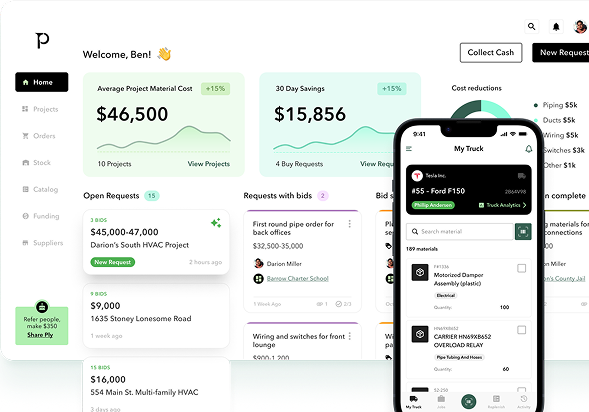
Ply

Managing and buying materials

Ply streamlines material procurement for MEP contractors with cost savings, payments, and supplier requests. Integrated with third-party fintech APIs like Plaid, Railz, Lendflow, and Stripe.

Fintech MVP Development Mobile Web SaaS MVP Development
Featured Cases

Why Businesses Choose Dotcode

Order management solutions

Order management solutions tailored to your logic – not off-the-shelf compromises.a

Post-payment model
Post-payment model

No upfront financial risk. Pay after milestones are delivered and validated.

100% code ownership
100% code ownership

All code and data in your repositories from day one. No vendor lock-in, ever.

Transparent reporting

Time-tracking logs and sprint reports shared with you – full visibility throughout.

Full-cycle delivery
Full-cycle delivery

We work as a custom software development partner – not a build shop that hands over a repository and moves on.

Frequently Asked Questions

Order management software is the system that handles what happens after a customer places an order – and before it arrives. It receives orders from every channel, routes them to the right fulfillment path, tracks status across the supply chain, and surfaces that status to both the operations team and the customer. An order management solution centralises all of that into one place rather than spreading it across spreadsheets, email, and three different portals.

Off-the-shelf tools are designed for a broad market. They’re fast to implement and they work well if your workflow matches their assumptions. Custom order management software is designed specifically for your business – your pricing logic, your channels, your fulfillment rules. The practical difference shows up the first time you need something the generic tool doesn’t support: with a custom system, you build it. With a SaaS tool, you wait for the vendor’s roadmap.

Yes. Order management software for small business is a specific service line we run – lightweight, fast to implement, without the feature bloat that makes enterprise tools unusable for small teams. Pre-built integrations for Shopify and WooCommerce keep scope lean. The codebase scales, so growth doesn’t force a platform migration.

Quite a few. B2B order management software builds here typically cover: account-level contract pricing, credit limits with hold logic, approval workflows for large or unusual orders, EDI (ANSI X12 and EDIFACT), and self-serve client portals. These are the features that wholesale distributors typically manage across email threads, spreadsheets, and phone calls – and that cause the most operational overhead when they’re not systematised.

Ecommerce order management software connects to Amazon, eBay, Shopify, WooCommerce, and Magento via direct API or middleware. Orders from each channel arrive in the OMS in real time. Inventory updates across all channels on dispatch. Tracking information goes back to the marketplace automatically. The goal is that a staff member never has to log into a marketplace dashboard to manage an order – it all happens in one place. Book a call to discuss your specific channel set.

An MVP covering core order management software development scope – order intake, basic routing, one or two integrations – typically runs 8–12 weeks. A full production system with a complete integration suite, B2B portal, and customer tracking layer takes 4–6 months, depending on how many external systems are involved. Use the estimator to get a scoped timeline and budget before committing to anything.

Yes, regardless of platform. Our order tracking software has been integrated with SAP, NetSuite, Dynamics 365, Odoo, and custom-built WMS systems. The order management system development work at this layer involves building a middleware service that manages the data flow between your OMS and existing systems, handles error states gracefully, and maintains a reconciliation audit trail – so you know what was sent, what was received, and when.

Ready to stop managing orders manually?

Tell us your order volume, your channels, and where the current setup is breaking down. We’ll define a scope and a cost in one call – no commitment required. Contact us or estimate your project to get a fixed breakdown before any work starts.