


Custom IoT Application Development

With IoT application development, manufacturers, MedTech and logistics teams manage every connected device from one app, not from vendor portals and CSV exports. We are an IoT application development company that builds the dashboards, mobile apps and backend behind it, and our IoT application development services end with you owning the code.

Why Companies Need a Custom IoT Application

Disconnected device data

Readings sit in vendor portals and CSV exports, so nobody sees the whole fleet in one place or compares it with business data, and reports take days to assemble by hand.

Clunky companion apps

Dropped Bluetooth sessions and slow screens push users away, support tickets pile up, and the app store reviews say so out loud.

No real-time visibility

Operators hear about a fault after the machine has stopped, because nothing warned them earlier. One unplanned stop usually costs more than the alert system would have.

Scaling and security gaps

An app that handled fifty devices falls over at a few thousand, and weak device authentication leaves the door open.

SERVICES

IoT Application Development Services

Our IoT application development services sit on the application layer: what operators and customers touch, plus the backend and integrations behind it. Firmware and hardware stay with your device team, or with our custom IoT development if you need the full chain.

01
Custom IoT Application Development

Built around your devices, protocols and user roles. UX, data model and alert logic follow your product, not a vendor’s template.

02
IoT Mobile App Development

iOS, Android and cross-platform apps that pair with devices over BLE, Wi-Fi or the cloud, walk users through setup and send push alerts. Our mobile app development team handles the build.

03
IoT Web Dashboard & Admin Portal Development

Live dashboards, maps and telemetry charts for operators, plus admin panels to manage users and devices.

04
IoT Cloud Backend & API Development

Telemetry intake over MQTT or HTTP, a device registry, rules engine and APIs for other systems, set up with our cloud solutions specialists.

05
Device Management & OTA Update Apps

Provisioning, fleet health, remote commands and over-the-air firmware updates from a single screen.

06
IoT Data Analytics & Alerting

Time-series analytics, thresholds and anomaly detection, with alerts to Slack, email or SMS. Heavier modelling draws on our big data expertise.

07
IoT Software Integration

IoT data connected to ERP, CRM, BI tools and outside APIs through our integration services.

Core Features

Core Features of an IoT Application

Whatever the industry, IoT software application development comes down to six features. Any IoT app development company can list them; the difference is how well they hold up on a flaky network and a big fleet.

1

Real-Time Device Monitoring Dashboard

Live status, location and readings for every device, filtered by site, model or customer. Result: operators spot trouble in seconds.

2

Device Onboarding & Provisioning Flow

Scan a QR code, pair over BLE, register in the cloud, done. Result: fewer setup calls to support and a shorter path from the box to the first reading.

3

Alerts & Rules Engine

Thresholds, schedules and combined conditions notify the right person. Result: faults are handled before equipment stops.

4

Remote Control & OTA Updates

Send commands, change settings and roll out signed firmware in stages. Result: no technician visits for routine fixes.

5

Historical Data & Analytics Reports

Time-series storage with trend views and exports for finance or compliance. Result: maintenance planned from data, not guesswork.

6

Role-Based Access & Device Authentication

Each user sees only their devices, and each device proves itself with its own certificate. Result: a fleet that grows without new security holes.

line on background
square on background

Who We Work With

1
Hardware & Device Manufacturers

Companion apps and fleet consoles for your own product line. Our IoT app development services replace the generic vendor portal your customers complain about, with your branding and your data model.

2
Healthcare & MedTech Companies

Apps that connect clinical or home-care devices, treat patient data carefully and give clinicians a clear view of each device and each patient.

3
Smart Home & Consumer Electronics Startups

IoT mobile app development for consumer devices: quick pairing, painless firmware updates and an app good enough to keep reviews high, built to scale from the first hundred units to the first hundred thousand.

4
Logistics & Fleet Operators

Live position, temperature and condition tracking across vehicles and cargo, with exceptions pushed to dispatchers before the customer calls about them.

5
Agriculture & Smart Farming Companies

Field sensors, irrigation and machinery in one view. Our article on IoT in smart agriculture covers the data side of it.

6
Smart Building & Facility Management

Energy, HVAC, access and occupancy data from many buildings in one console, with alerts for facility teams and reports for building owners.

CUSTOM VS PLATFORMS

Custom IoT Application vs Generic IoT Platforms

ThingsBoard or Blynk can get a prototype running quickly. Custom IoT application development pays off when your devices, brand and integrations do not fit their widgets. IoT application development solutions for a product you sell need more control than a platform allows. For the wider build, see our custom software development.

Fits your device & data model
Generic IoT platforms (ThingsBoard, Blynk, no-code builders)

Adapt your devices to the platform

Custom by Dotcode

Built around your exact devices and protocols

UX & branding
Generic IoT platforms (ThingsBoard, Blynk, no-code builders)

Fixed widgets and templates

Custom by Dotcode

Fully custom, white-label ready

Integration depth
Generic IoT platforms (ThingsBoard, Blynk, no-code builders)

Pre-built connectors only

Custom by Dotcode

Any ERP, CRM, cloud or data source

Scalability across device fleets
Generic IoT platforms (ThingsBoard, Blynk, no-code builders)

Tier limits and per-device pricing

Custom by Dotcode

Architected for your fleet size

Security & compliance
Generic IoT platforms (ThingsBoard, Blynk, no-code builders)

Varies by vendor

Custom by Dotcode

Built into architecture

Code & data ownership
Generic IoT platforms (ThingsBoard, Blynk, no-code builders)

Vendor-owned

Custom by Dotcode

100% yours from day one

Outgrowing a no-code IoT dashboard but not ready to rebuild your whole stack?

Let’s build an application that fits your devices and your users.

Book a call
Process

Development Process

Our IoT app development services follow six steps. The same IoT application development services process applies to a first app and to the rebuild of an existing one.

1

Discovery & Use Case Mapping

We list your devices, users, data volumes and the decisions the app should support, and agree what the first release must do.

2

UX/UI Design for Operators & End Users

Dense dashboards for professionals, simple screens for consumers. Both are tested as clickable prototypes with real users before development.

3

Architecture & Connectivity Planning

Protocols, cloud services, data model and API contracts are settled before coding. Bigger strategy questions go to IoT development consulting.

4

Agile Development

Short sprints with working builds, tested against real devices from the second sprint, so surprises show up early.

5

QA & Device Testing

Checks on real hardware, on weak networks, and under load from thousands of simulated devices.

6

Launch & Post-Launch Support

Staged rollout, monitoring and fixes while the fleet grows, plus a plan for app store updates.

Tech Stack

Tech Stack for IoT Application Development

The stack follows your devices and fleet size. These are the tools behind most IoT application development solutions we deliver, and the ones we pick in IoT software application development when reliability matters more than novelty.

Need help selecting the right stack?

Let’s talk!

Nazar Solovei
Nazar Solovei CTO at Dotcode
Let’s talk
Backend
Backend

Node.js, Python, Java, .NET

Frontend & Mobile
Frontend & Mobile

React, Next.js, React Native, Flutter

IoT Cloud & Messaging

AWS IoT Core, Azure IoT Hub, MQTT, Kafka

Protocols
Protocols

BLE, Wi-Fi, LoRaWAN, Zigbee, CoAP

Databases
Databases

PostgreSQL, TimescaleDB, InfluxDB, Redis

Security
Security

OAuth 2.0, TLS 1.3, X.509 device certificates, RBAC

Need help selecting the right stack?

Let’s talk!

Nazar Solovei
Nazar Solovei CTO at Dotcode
Case Study

Featured Case Study

All cases

XO Armor

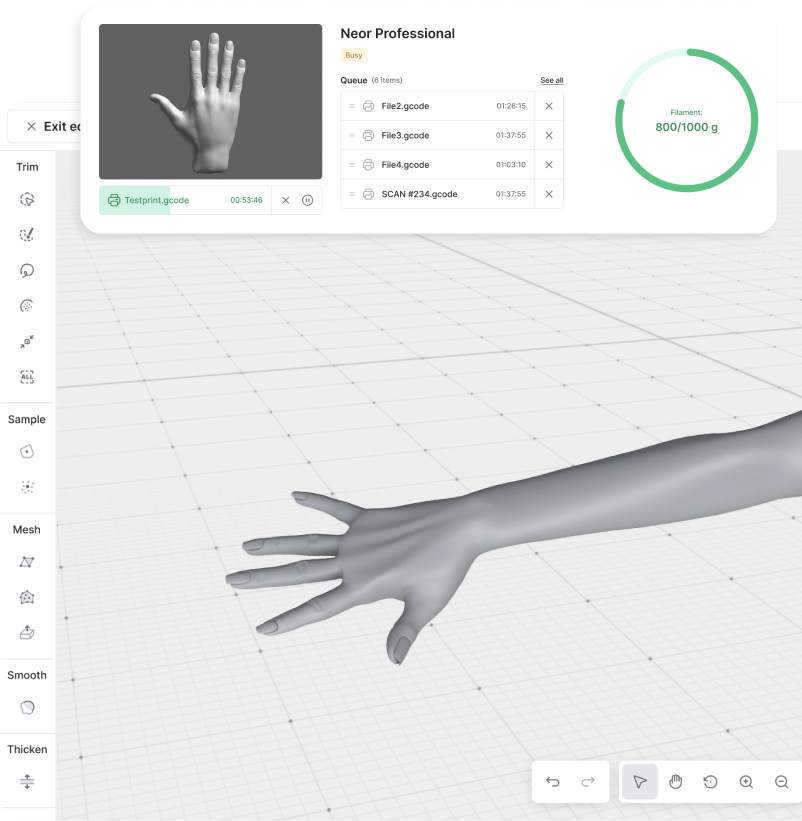
A 3D medical scanning & printing platform for custom orthosis devices

Client: XO Armor, a US healthcare company producing orthosis devices.

Challenge: Providers had to treat patients far from standard healthcare infrastructure, and no single app covered scanning, editing and printing an orthosis. Doctors juggled three separate apps to get one result.

Solution: One desktop application for doctors with different levels of tech skill. It processes scan data into an orthosis model ready for 3D printing and connects to a 3D printer, on top of a reliable architecture for the whole pipeline.

Result: Three tools became one. A printable model takes a few clicks, which shortens lead times and speeds up patient care. The work involved real-time device interaction and data processing, the same core as an IoT app.

MedTech 3D Scanning Desktop App Device Integration
Case Study

Why Businesses Choose Dotcode

Built around your devices

IoT application development shaped by your devices, protocols and user roles, not by platform templates and their fixed widgets.

Security from day one

Device authentication, encryption and OTA signing sit in the architecture, not in a patch after launch. Your security team can review it early.

Post-payment model

No upfront financial risk. You pay for software that has been delivered and tested, not for hours spent.

You own everything

100% of the code and data is yours from day one. No vendor lock-in, and no licence fee for your own app.

Full-cycle delivery

Discovery, UX design, development, device testing, security review, launch and support, all from one team.

Frequently Asked Questions

IoT application development is building the software people actually use to work with connected devices: mobile and web apps, dashboards, and the cloud backend and APIs that collect telemetry and pass it on. It does not include firmware or hardware design. We focus on that application layer, so your devices become something operators and customers can monitor and control, and so the data reaches the systems your business already runs on.

At minimum: live monitoring, onboarding, alerts, remote control, historical reports and proper access control. Beyond that, IoT software application development depends on who uses the app. Operators need density and speed, consumers need simplicity. A reliable IoT app development company asks about both groups first and pushes back on anything that can wait for version two. Fewer features at launch usually means a better app.

A first working version of a custom IoT application development project usually takes three to six months, depending on device types, roles and integrations. A mobile-only companion app can be quicker, a multi-tenant platform with analytics slower. An IoT application development company can only give a firm date after discovery, which is why we start there. Fixed scope and early access to test devices matter more for speed than team size.

It depends on device types, platforms, integrations and fleet size. A single-platform companion app and a multi-tenant monitoring portal sit far apart. Our IoT app development services are estimated after discovery, and the IoT application development solutions we propose can be split into phases, so you can start small. For a rough range, try the free estimator.

Usually, yes. If your devices already expose a BLE profile, a cloud API or MQTT topics, IoT mobile app development is mostly app work. If they do not, we agree the interface with whoever owns the firmware. A custom build can sit on top of existing hardware without touching it, as long as we get documentation and test units. We would rather test early than discover an undocumented command in week ten.

On connectivity we work with MQTT, HTTP, CoAP, BLE, Wi-Fi, LoRaWAN and Zigbee; on the cloud side, AWS IoT Core, Azure IoT Hub and Kafka. We choose by fleet, not by preference. Most projects mix two or more of these, and each has quirks the app must handle, such as BLE reconnects and retries on a weak mobile signal.

As an IoT application development company we treat security as design input. Each device gets its own X.509 certificate, traffic runs over TLS 1.3, users get role-based access and firmware updates are signed. Any IoT app development company that leaves security to the last sprint is creating risk for you. We also run a security review before launch and plan for how credentials are rotated and revoked over the fleet’s lifetime.

Ready to turn raw device data into an application your team and customers actually use?

Let’s build an IoT application that connects your hardware to your business.